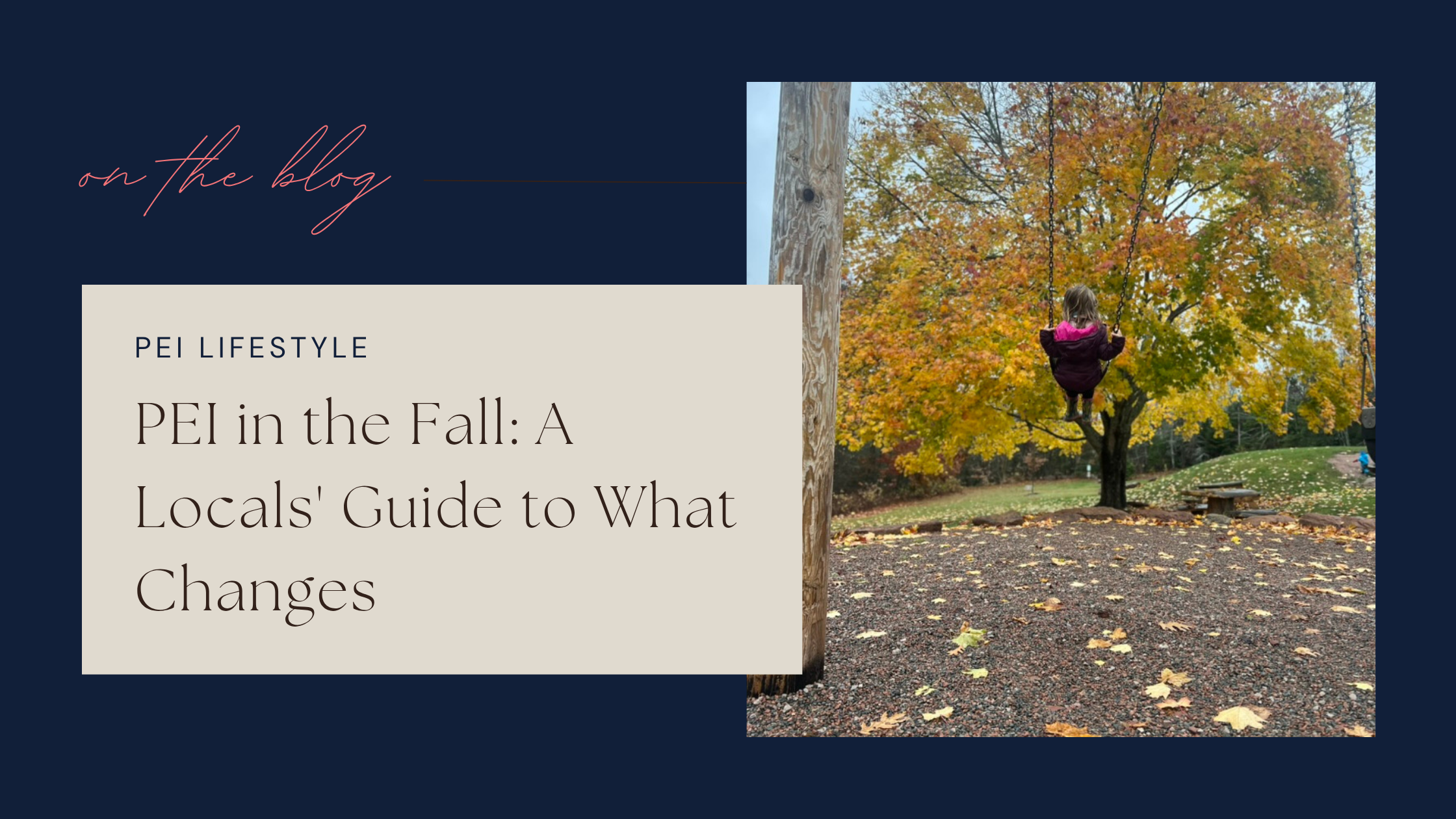
PEI in the Fall: A Locals' Guide to What Changes
Never spent a fall on PEI? Cavendish empties out, downtown traffic turns into cruise ship traffic, and it's time to line up snow tires and mouse-proofing. Here's what actually changes once summer wraps up.
If you've never spent a fall on Prince Edward Island, here's your heads up — it's a completely different island than the one you fell in love with in July. Not worse. Just different. Here's what to expect. [If you're still weighing the move itself, Relocating to PEI: Everything You Need to Know About Buying a Home Here is a good place to start.]
Cavendish goes quiet. Most of the stores and restaurants around Cavendish close up by Labour Day, and the place basically turns into a ghost town overnight. If you're used to summer Cavendish — packed parking lots, lineups for ice cream — don't plan a visit out that way expecting the same energy in September or October. It's a good reminder to explore it in summer if you haven't yet, because it hibernates hard.
Downtown Charlottetown traffic gets weird — but for a different reason. Once the summer road-trippers thin out, downtown traffic becomes almost entirely about cruise ship days. When a ship's in port, the downtown core fills up fast with foot traffic and tour buses. Check the cruise schedule if you've got errands downtown and want to avoid the crowds [or lean into it and grab a coffee people-watching, your call]. If you're still deciding which part of the greater Charlottetown area suits you, Should I Live in Charlottetown, Stratford, or Cornwall? walks through the differences.
Farmer's markets hit their peak. Fall is actually the best time to hit up the farmer's markets on the island — produce, preserves, baking, all of it is at its best right now. If you haven't made it a Saturday habit yet, this is the season to start.
You'll want layers. Days can still get genuinely warm through September and into October, but mornings and evenings get crisp fast. Keep a sweater and a pair of pants in the car — you'll be glad you did more mornings than not.
Hiking, corn mazes, and apple picking are the season's favourites. These are the go-to fall activities islandwide, and hiking especially is worth prioritizing as you get into October — that's when the leaves hit peak foliage and the trails are stunning. Get out there before it fades.
If you've got kids, or you're coming from a place without real winter, start prepping now. Fall is your window to get ready before the snow actually hits — snowsuits and cold-weather gear for the kids, snow tires on the car, and a plan for snow removal (shovel, snowblower, or a plow guy lined up) all need to happen before you need them, not after the first storm. This part catches a lot of relocation folks off guard [it's a different kind of winter prep than "bring a coat"], so get it sorted while it's still convenient. Same goes for lining up a doctor or walk-in clinic before you actually need one — Getting Medical Care in PEI: Walk-In Clinics, Maple, and What You Need to Know Before You Move covers what to set up in advance.
Mice will try to move in too. With so much green space around — yes, even in town — fall is when field mice start looking for somewhere warmer to spend the winter, and your house looks pretty good to them. Seal up gaps around the foundation, doors, and where utility lines enter the house before it gets cold. It's a normal part of island living, not a reflection on how clean your house is [I've got my own mouse story from when I was pregnant with my first — ask me sometime].
Fall on PEI has its own rhythm, and once you know what to expect, it's honestly one of the best seasons here — quieter, crisper, and full of its own reasons to get outside.
Got more questions about what island life is actually like? Your Questions Answered: Moving to Prince Edward Island rounds up the ones I get asked most.

Retiring on PEI: What to Know Before You Downsize
Thinking about downsizing on PEI? Here's what to actually expect — housing options, timing your sale, and the emotional side nobody warns you about.
Hiya!
A good chunk of the folks I work with aren't buying their first home — they're leaving their last big one. Empty nest, too many stairs, a yard that's turned from a hobby into a chore. If that's you, here's what I tell clients thinking about downsizing or retiring on PEI.
Why people make this move
It's rarely about the house itself. It's about what the house is costing them — in upkeep, in energy, in time they'd rather spend doing something else. PEI adds a specific pull on top of that: a slower pace, water everywhere you turn, and a community size where you actually run into people you know at the grocery store [in a good way, mostly].
The housing reality — no sugar-coating it
Single-level or easy-care homes exist here, but condo inventory is thin. If you're picturing a lock-and-leave condo lifestyle like you might find in a bigger city, PEI isn't that market yet. What you'll find more of: bungalows, smaller single-family homes, and the occasional purpose-built retirement community. I'll tell you straight if what you're picturing doesn't match what's actually available — better to know that now than after you've packed the truck.
Questions worth answering before you list your current place
Be honest with yourself about square footage. Most downsizers are surprised how little space they actually need day to day. [Bonus tip: this is a great excuse to finally make the kids come collect everything they've had "stored" in your basement since university.]
Is this a permanent move, or do you want flexibility to travel part of the year?
Do you want to be walkable to town, or are you fine driving in for groceries and appointments? Worth a read: Charlottetown Neighbourhoods: Where Should I Buy?
Have you thought through healthcare access? I wrote a separate post on getting medical care set up on PEI [walk-in clinics, Maple, the whole thing] — worth a read if this is on your mind.
Should you sell first or buy first?
This is the question I get most, and there's no one right answer — it depends on your comfort with risk, your current mortgage situation, and how tight the timing needs to be. I've written more on renting vs. buying right away if you're not sure which path fits you. Ultimately this is your decision, and you have to be comfortable with the choice you make — my job is making sure you have the full picture before you decide.
A note on decorating to sell
If your REALTOR® suggests decluttering, depersonalizing, or repainting that accent wall before your home goes on the market, that's not a jab at how you've lived in your house. Decorating for living and decorating to sell are two different jobs — one is about comfort and personality, the other is about helping the most possible buyers picture themselves there. It's not personal, and it's not about what's "wrong" with your home. It's about optimizing the space for sale, full stop. I go into this more in Prepping a Home to Sell vs. Living In It — The Honest Gap.
The part nobody warns you about
Downsizing isn't just a real estate transaction — it's an emotional one. You're not just selling square footage, you're sorting through decades of stuff and deciding what comes with you. Give yourself more time for that part than you think you need. I've seen it take longer than the actual home sale.
If you're weighing a move like this — whether that's a year out or you're ready to list next month — I'm happy to talk through what it actually looks like for your situation. No pressure, just the real picture.
Chat soon! Amy
Why Are People Moving to PEI in 2026?
Why are people moving to PEI? Slower mornings, safer lives, family roots, and more space for your money — five reasons I hear every week.
Hiya!
If you follow our Move to PEI Facebook group, you already know the messages don't stop. People reaching out from all over — Ontario, Alberta, the US — asking the same underlying question in a dozen different ways: is this actually a good move for us?(Here's one resource I always point people to first.)
After enough of these conversations, patterns start to show up. Here are the five reasons I hear most.
1. They want their kids to just be kids
A lot of parents tell me some version of the same thing: they want their kids to have the kind of childhood they had — riding bikes to a friend's house, playing outside until the streetlights come on, not being shuttled everywhere because it isn't safe to walk. On PEI, that's still normal. Not because we're trying to sell you a postcard, but because the island is small enough that kids can actually roam, and communities here still know each other's names.
I would say "just ask my kiddos" — but they're probably off riding their bikes with their friends around the neighbourhood.
It's not just about the kids' time, either. Long commutes just aren't the norm here. No hour each way sitting in traffic. That time comes back to you as a family — more of it at the dinner table, more of it outside together, more of it just being around each other. When new families tell me they are okay with a 45 minute commute, I like to encourage them to imagine their days where they can have 30 minutes to an hour of more time with their family 5 days a week if they aren’t commuting. It’s not a judgement, just most people have never thought about a world where they don’t spend 2 hours, (sometimes 3 or 4 if there is an accident, inclement weather or construction) in the car going to and from work.
If you're weighing where a family-centric neighbourhood actually is around here, I wrote a full breakdown: Should I Live in Charlottetown, Stratford, or Cornwall?
2. They're ready to slow down
Retirement is a big one. People are done with the pace of a bigger city — the traffic, the noise, the constant push — and they want a slower way of life without giving up community. PEI gives you that. Smaller towns, a slower rhythm, and still enough going on that you're not isolated.
There's a financial piece to this too. Cost of living on PEI has gone up like everywhere else, no question. But compared to a city like Toronto or Vancouver, home prices here are still significantly lower. That means retirees can cash in the equity built up in their city home and turn it into a smaller, low-maintenance place on more land — often with money left over. Worth budgeting for the extras beyond the purchase price too.
3. They're looking for somewhere safer to live as who they are
This one comes up more than people might expect, and I want to be honest about it rather than gloss over it. Some of the folks reaching out are members of the LGBTQ+ community, largely from the US, who no longer feel safe where they are and are looking at Canada — PEI specifically — as somewhere they can live without that fear. I've had many questions from this community about what it's actually like here. I hope my answers have been what they were looking for, and I hope PEI is as welcoming to this community as I want it to be.
4. Work brought them here
Relocation for a job is still one of the most straightforward reasons — nursing, government, construction, and a handful of other sectors bring people to the island regularly. Sometimes it's a transfer, sometimes it's a spouse's job, sometimes it's someone who did the math on remote work and realized they didn't need to stay put anymore. If you are wanting to know more about job searching on PEI - stick around - that will be coming shortly!
5. They're coming back to their roots
This one's harder to explain but I hear it all the time. Maybe you grew up here and you're finally ready to move "home." Maybe your grandmother was from the island and you've always felt a pull to it, even having never lived here. Maybe you grew up reading Anne of Green Gables and you're out here looking for your own Gilbert. Whatever the version, the story is the same — something in you just knows PEI is home, and you're ready to start living your island life.
Here's the thing about all five of these: they're not really about the house. They're about the life someone's trying to build around it. That's honestly most of what I do with relocation clients — less "here's a listing" and more "let's figure out what you're actually looking for, and whether PEI delivers it for you."
I've written before about why I love working with people making the jump to relocate to PEI — it's genuinely my favourite part of this job.
Ultimately, I want people to really think about their island life and how they're wanting to live. When we made our own move, we were looking for a family-centric neighbourhood in the Charlottetown area, and that's exactly what we found. Every day after school, our kids get off the bus, grab a snack, and head out with their friends. There's no shortage of extracurricular options for them, and we love the childhood they're having. We're only 10–20 minutes from the beach depending on which direction you go, and we have close family and friends nearby. That's what island life looks like for us — yours might look different, and that's the fun part of figuring it out.
If you're weighing a move for any of these reasons — or a completely different one — happy to talk it through. Ultimately this is your decision, and you have to be comfortable with the choice you make. I can just help make sure you're making it with your eyes open.
Chat soon! Amy
![What happens in our initial [onboarding consultation] meeting before looking at homes](https://images.squarespace-cdn.com/content/v1/63c6d444593752090a3c98ab/1785848296452-URFRTWXGG0K9R6C5DC33/Copy+of+Blog+Banner.png)
What happens in our initial [onboarding consultation] meeting before looking at homes
Think your home search starts with a batch of listings? It doesn't. Here's what actually happens first — and why skipping it costs first-timers and relocation buyers the most.
If you're picturing your home search starting with me sending you a batch of MLS listings, I want to reset that expectation right now.
It doesn't start there. It starts with a conversation.
Before we look at a single house, we sit down for what I call the onboarding consultation. No paperwork gets signed at this meeting — it's just us, talking through what buying actually looks like so you walk into your search knowing what to expect instead of figuring it out as you go.
I like to do this in person when we can swing it, but a video chat works just as well if you're not on the Island yet — especially handy for relocation buyers who are still a plane ride away.
It's Also a Fit Check — Both Ways
Here's something people don't always expect about this meeting: it's not just me learning your budget and timeline. It's us figuring out if we're the right people to work together.
As a REALTOR®, I end up privy to information most new acquaintances don't get. Are you planning to grow your family? How many bedrooms do you actually need — not just right now, but in five years? Those aren't small-talk questions. They change what we should be looking at. And I ask them with zero judgment — there's no "right" answer, I just need to know what I'm working with.
I'm also a mom myself, so when I walk through a house, I'm not just thinking about square footage. I'm thinking about what it's like to actually raise kids in it — sightlines from the kitchen, where bath time happens, whether that "fenced yard" in the listing photos is real fencing or a suggestion. Those are the kinds of things you might not think to ask about yet. I do, because I've lived it. [Ask me sometime about the house I toured where I clocked the staircase as a toddler hazard before I'd even looked at the listing photos.]
So yes — we're talking budgets and paperwork. But we're also figuring out whether my perspective is one you actually want in your corner.
Here's exactly what we cover.
Making Sure Your Budget Is Real
We talk pre-approval first — not because it's a box to check, but because "what you can afford" and "what a lender will actually approve you for" aren't always the same number. I want you shopping with a real budget, not a guess. If you haven't saved a full downpayment yet, it's worth reading about PEI's down payment assistance programs before we meet — there's a good chance you qualify for more help than you think.
A Walkthrough of the Paperwork — Before You Need It
I show you the Agreement of Purchase and Sale before you're staring at one under pressure. Here's why that matters: on PEI, good properties can move fast. If we find the right home and need to write an offer quickly, I don't want the first time you're seeing that document to be the moment you're also trying to decide if you love a house enough to buy it. We look at it together, calmly, ahead of time.
Your Homework: Needs, Wants, Deal Breakers
You leave this meeting with an assignment — sorting out your needs, wants, and deal breakers. [Yes, actual homework. I was a teacher first — old habits.] This isn't busywork. It's what keeps your search focused instead of you wandering through 40 listings that don't actually fit.
And it's not set in stone. Once we actually start touring homes, that list often shifts — something you thought was a deal breaker turns out not to matter, or a "want" moves up to a "need" the second you see it in person. That's normal. We just keep adjusting as we go.
Talking Timeline (This Is Where the Misconceptions Show Up)
This is usually the part that surprises people most — and it looks different depending on who you are.
First-time buyers often underestimate how long the whole process takes, start to finish. We talk through a realistic timeline so "how long is this going to take" isn't a mystery three weeks in.
Relocation buyers run into a different misconception — distance. Charlottetown to Summerside is 45 minutes. Some people do commute that route either way — it happens. But if you're used to commuting in a city, don't assume it feels the same here: it's 45 minutes of straight highway driving, not stop-and-go traffic you can zone out through.
And here's my honest advice on it: if part of why you're moving to PEI is a slower pace of life with your family, don't sign yourself up for a commute you don't actually need. Land somewhere that gets you the life you're relocating for, not one that just recreates your old commute with better scenery. I get into more of this — plus healthcare, daycare, and schools — in my Moving to PEI FAQ post.
Deposit vs. Downpayment (They're Not the Same Thing)
I explain the difference early because people mix these up constantly:
Downpayment — part of your mortgage, handled with your lender.
Deposit — the money you put down with your offer, usually within 48-72 hours of acceptance. It's a separate thing. The funds do go toward the home [you will see it on the statement of adjustments] and if you decide to not purchase the home within the conditional period, these funds are returned to you.
We also talk about how much cash you'll want available to cover both your deposit and your inspection costs, so there are no surprises when an offer moves fast. If you want the fuller cost breakdown ahead of time, I've laid out real inspection and closing cost ranges in this post on renting vs. buying on PEI.
A Preview of the Statement of Adjustments
You'll get this from your lawyer before closing, and I'd rather you see it coming than be confused by it later. We talk through what it is now so it's familiar when it lands in your inbox.
The PEI-Specific Stuff (When It Applies)
Depending on what you're looking for, a few Island-specific pieces come up:
IRAC — if we're looking at rural or waterfront property, this becomes part of the conversation. I've written a full breakdown of what IRAC actually is and when it applies if you want the details ahead of time.
Non-resident property rules — if you're relocating from outside Canada, PEI has restrictions on non-resident land purchases that can affect what you're able to buy. We talk through how that applies to your situation.
Dual agency — only comes up if you're interested in one of my own listings. If that happens, I'll walk you through exactly what it means and how it works.
What Doesn't Happen at This Meeting
Nothing gets signed. This isn't a commitment meeting — it's a groundwork meeting. The goal is that you leave informed, not obligated.
What You Walk Away With
Two homework items: get your pre-approval completed, and fill in your needs/wants/deal-breakers sheet. Beyond that, you'll have a realistic sense of the timeline and a decent understanding of the paperwork and terms you'll run into later. When we do find the right home, you're ready to move on it — not learning the process for the first time under pressure.
If you're thinking about buying on PEI and want to know what that first conversation actually looks like, that's exactly what this meeting is for.
Buying a Home in PEI vs. the US: What's Actually Different?
Thinking about buying in PEI as an American? From the Lands Protection Act to Canada's mortgage rules, here's what actually changes.
Hiya!
If you're one of the folks in my Move to PEI group dreaming about island life, chances are you've bought a house before — just not here. (If you haven't seen my guide to planning the move yet, that's a good companion read to this one.) A lot of what you know from buying in the US doesn't carry over. Here's what's actually different, not the Pinterest-board version.
1. A lawyer closes your deal, not a title company.
In the US you're used to title companies, escrow agents, sometimes closing attorneys — a whole cast of characters holding funds and clearing title. Here, one real estate lawyer handles it. They do the title search, register the deed and mortgage, and manage the funds. No escrow company in the mix.
Your lawyer also gets a window in the purchase agreement to actually review the property's legal title before things move forward. If anything comes up — old liens, boundary issues — that's when it surfaces.
Here's the part that trips people up: signing the closing documents can happen anywhere from a couple of days before closing to closing day itself — but even if you sign on closing day, you won't get your keys until later that day. Keys depend on money actually moving between the two law firms and the deed getting registered with the province, and that can take until late afternoon or end of day. [We try not to schedule closings on a Friday for exactly this reason — if something holds it up and you don't close by end of day, you're not closing until Monday at the earliest.]
2. Financing works differently — the "stress test" is real.
Canadian lenders don't just qualify you at your mortgage rate. They qualify you at whichever is higher: your contract rate plus 2 percentage points, or 5.25%. So if you're approved for a 5% rate, the bank is checking whether you could still handle payments at 7%. This typically cuts borrowing power by somewhere in the 15–25% range compared to what US qualifying rules might allow — that range is approximate, so lean on your mortgage broker for your actual number, not mine.
One thing that has changed recently: as of 2025, the stress test no longer applies when you renew your mortgage and stay with the same lender. Doesn't help you on a first purchase, but good to know down the road.
Here's the other big one: your rate doesn't lock in for the life of the loan the way a US 30-year fixed does. In Canada, your mortgage is amortized over a longer period (often 25 years), but you're only locked into a term within that — 5-year fixed is probably the most common, though variable terms exist too (I'm personally in a 3-year variable right now). Near the end of your term, your lender reaches out to renew you — and that's also your chance to shop around for a better rate or product with a different provider instead of just accepting the renewal.
One knock-on effect of those shorter terms: you won't see "rate buydowns" here the way you might in the US, where a builder or seller pays to lower your rate for the first couple of years of a 30-year loan. With Canadian terms being so much shorter, that kind of temporary buydown just isn't really a product in this market.
3. There's a limit on how much land you can buy.
This is the big one Americans never see coming. PEI has a law called the Lands Protection Act that caps how much land a non-resident can buy without government approval: 5 acres, or 165 feet of shore frontage, whichever applies. Go over that and you need approval from the Island Regulatory and Appeals Commission (IRAC) before the sale can close.
For real estate purposes, you're generally considered a resident only if you've both lived on PEI for 12 of the last 24 months and filed your provincial income tax here during that time — it's not either/or, you need both. So even Canadians from other provinces can hit this rule — it's not just an "American thing."
If you do need IRAC approval, the application fee is whichever is greater: $550 or 1% of the purchase price. [Not nothing, so worth building into your budget if you're eyeing acreage or waterfront.] Practically, this shows up as an added conditional clause in your Agreement of Purchase and Sale — the deal is conditional on IRAC approval coming through, same as a financing or inspection condition would be.
Here's the part that surprises people: even if you're genuinely planning to relocate to PEI, IRAC can still deny an application. One of the factors they weigh is how concentrated non-resident ownership already is in that specific community — what we in the industry sometimes call "red zones." We've seen applications turned down purely because too much of that area is already non-resident owned, regardless of the buyer's intentions. [Not an official legal term, just how agents talk about it — but the underlying factor is real, so it's worth asking about before you fall for a specific property.]
The rules around this have been getting tighter, not looser — there's been recent movement to close loopholes on smaller parcels too, so if land size matters to your plans, this is a conversation to have with me early, not after you've fallen in love with a listing. I've written more on how IRAC works for both renters and buyers here, if you want the fuller picture.
4. There's also a federal ban on foreign buyers to consider.
Separate from the provincial land rules above, there's a federal law — the Prohibition on the Purchase of Residential Property by Non-Canadians Act — that blocks non-Canadians from buying residential property in certain areas. It's been extended a few times and is currently set to run through January 1, 2027, so treat that date as subject to change and worth checking closer to when you're ready to buy.
It applies to residential properties (homes with three units or fewer) inside larger population centres — specifically Census Metropolitan Areas (100,000+ people) and Census Agglomerations (10,000+ core population). Charlottetown is classified as a Census Agglomeration, so this ban does apply to Greater Charlottetown, which is the area most of my relocation clients are looking at.
CMHC has an actual lookup map where you can check whether a specific area falls inside a restricted zone: CMHC Zone Lookup tool. Worth punching in the specific community you're considering rather than assuming based on what I've said here.
There are real exemptions, though: recreational properties like cottages, vacant land, and larger buildings are exempt outright, and areas outside those population thresholds are exempt too. Work permit holders with at least 183 days of remaining validity can also buy. [This is genuinely one to run by an immigration lawyer or accountant based on your specific status — not something to guess your way through.]
5. There's a transfer tax, but first-time buyers often skip it.
PEI charges a flat 1% Real Property Transfer Tax on the greater of the purchase price or the assessed value.
First-time buyers can be fully exempt from that 1% tax, with no price cap on the exemption itself — but you have to be a Canadian citizen or permanent resident, plan to live in the home as your principal residence, and either have lived in PEI for six months before the purchase or filed income tax here at least twice in the past six years. I'd treat that last detail as something to verify with your lawyer or accountant, not something to assume you qualify for. If you're a first-time buyer more broadly, I've got a few practical hacks worth a read too.
6. Commissions and offers feel familiar, but the paperwork culture is different.
The offer-to-purchase process — submit an offer, negotiate, get it signed, conditions like financing and inspection — will feel recognizable. What's different is how much of it runs through your lawyer rather than a title company, and how much less "signed buyer agreement" bureaucracy there is compared to what's become standard in parts of the US.
One more thing worth knowing: any agent registered with PEIREA (the Prince Edward Island Real Estate Association) can show you any home on the MLS — you don't need to go through the listing agent to see a property. PEI also allows dual agency, meaning the listing agent can represent both the seller and the buyer on the same sale. That's not the case in every Canadian province, so if you've bought elsewhere in Canada, don't assume the same rules apply here.
That said, "any agent can show any home" doesn't mean every agent knows every corner of the island equally well. Most of us work across the province, but we all have regions we're more familiar with — and that varies REALTOR® to REALTOR®. [My own home turf is Greater Charlottetown and the communities right around it, but I work Summerside and all points east.] Worth asking any agent you're considering where their real, on-the-ground familiarity lies — I've actually put together a list of questions worth asking any REALTOR® during a consultation, this one included.
The bottom line
None of this makes buying here harder — it's just a different system with different players. If you're not a Canadian citizen or permanent resident, the two things I'd flag first are the Lands Protection Act and the federal foreign buyer ban, because between them they can shape which properties are even on the table for you. Everything else is mostly about knowing who does what: lawyer instead of title company, IRAC instead of nothing, a flat transfer tax instead of a patchwork of local ones.
If you're at the stage of figuring out what any of this means for your specific situation, that's exactly what my onboarding conversation is for. No pressure, no sales pitch — just making sure you're not caught off guard by anything on this list.
Chat soon, Amy
This post is general information based on current rules as I understand them — always confirm the specifics (especially tax thresholds and Lands Protection Act limits, since both have been changing recently) with your lawyer or accountant before you rely on them.

Getting Medical Care in PEI: Walk-In Clinics, Maple, and What You Need to Know Before You Move
What happens if you get sick in PEI before you have a family doctor? Walk-in clinics, Maple virtual care, and the Patient Registry waitlist, explained — plus the prescription and referral prep that makes the transition easier.
If you're thinking about moving to PEI, "what happens if I get sick and don't have a doctor" is probably somewhere on your worry list. It's a fair question — PEI has a real family doctor shortage, and it's one of the most common things people ask me in the Move to PEI group. So let's talk about it honestly.
The short version
You will not be assigned a family doctor the day you land. You'll go on a waitlist called the Patient Registry, and depending on where you land on it, that wait can be long. In the meantime, you have two main options for non-emergency care: walk-in clinics and Maple (virtual care). Even when you are assigned a doctor, receiving acute care for infections and sickness can be hit or miss, depending on how your doctor operates so you may still be reliant on walk-in clinics even when you have a family doc.
Here's how each one actually works.
Walk-in clinics
They run first-come, first-served — no appointment needed.
Registration typically opens around 8am, and clinics close registration early once they hit capacity for the day. Get there early if you can.
You'll need your PEI Health Card to be seen without paying out of pocket.
The part most newcomers don't know about: several clinics use an online booking system called Skip the Waiting Room.
It's still first-come, first-served — the line-up for it starts at 7am, same as showing up in person. What it actually gets you is certainty: registering online tells you sooner whether you're getting in to see a doctor that day, instead of driving over and finding out only once you're standing in line. There's a small booking fee (a few dollars) for registering online; registering in person is still free. Not every walk-in clinic offers it, so check whether your closest one does before you plan around it.
[Bracket aside: for the clinics that don't offer online booking, it's back to the "show up early, bring a book, and don't take it personally if they close registration before you get in" system. It's not glamorous but it works for non-urgent stuff.]
Maple (virtual care)
Maple is a virtual care platform — you talk to a doctor by phone, text, or video for things like prescription refills, requisitions, or referrals.
The important part: the province only covers Maple for free if you're on the Patient Registry waitlist and get invited by Health PEI directly. You book through Health PEI, not through the Maple app itself — private bookings through Maple ask for payment. There was a plan to make Maple free for all Islanders regardless of waitlist status, but as of mid-2026 that expansion has been paused. So if you land in PEI and aren't yet registered, don't assume Maple is automatically free for you — check your status first.
My experience with chronic headaches while using Maple is that I was referred through Maple to a primary care physician. But those appointments are only available through Maple when you have a need that cannot be assessed online.
What covers you while you're becoming a PEI resident
If you're moving from another Canadian province, there's a gap you should plan for: PEI has a three-month waiting period before your new PEI Health Card coverage kicks in — coverage generally starts the first day of the third month after you establish residency.
The good news: your previous province's health plan typically continues to cover you during that gap, under the reciprocal billing agreements between provinces. So if you move from, say, Ontario or Nova Scotia, keep your old health card active and don't cancel it the day you arrive — it's what's covering you medically until your PEI card activates. Confirm the specifics with your old province before you move, since the rules and timing can vary depending on where you're coming from.
If you're coming from outside Canada, this doesn't apply the same way — international arrivals may be eligible for coverage starting sooner, but it's worth confirming your specific situation directly with PEI Health PEI or an immigration advisor, since status and permit type affect it.
Apply for your PEI Health Card as soon as you arrive regardless — processing itself can take several weeks on top of the waiting period, so the earlier you start, the sooner you're covered.
Getting on the Patient Registry (the actual process)
Straight from Health PEI's own FAQ, here's what you need to know about the waitlist itself:
To be eligible, you need:
A valid PEI Health Number
To be a permanent resident of PEI
No existing primary care provider
How you register: online through the Patient Registry form, by phone (1-855-563-2101), or in person at any Access PEI location. You'll need each household member's Health Card (or Health Card number + date of birth if you don't have the card yet).
How matching actually works: it's based on your application date, provider availability, and region — not a strict "first come, first served" line the way it sounds. Health PEI now lets you pick a secondary preferred region in addition to your primary one, which can help you get matched sooner (just make sure you could realistically travel there for appointments). A few things can also move someone ahead of you legitimately — a new baby joining the household, a family member with more complex care needs, or a retiring doctor flagging existing patients for continuity of care. So if a friend who registered after you gets matched first, that's usually why.
While you wait: you're confirmed eligible for Maple virtual care the entire time you're on the registry, and Health PEI will check in with your household twice a year to confirm you're still looking and keep your contact info current.
Other things worth knowing
811 — PEI's health advice line — is free and available if you need guidance on whether something needs a doctor visit.
Emergency departments at Queen Elizabeth Hospital (Charlottetown) and Prince County Hospital (Summerside) are there for actual emergencies — not a substitute for the above, but good to know where they are.
Get on the Patient Registry as early as possible after you arrive. It's a waitlist, not an appointment — the sooner you're on it, the sooner your name moves up.
Two things I tell everyone before they move:
Get your prescriptions renewed before you move — ask your current doctor for a full year of refills if they'll do it. You don't want to be trying to find a new provider to renew something a month after you land.
If you're under specialist care, have that specialist send a referral ahead of your move. This matters most for ongoing care — say your kids see a pediatrician, or you see a specialist for something chronic. Have your current provider send the referral directly to a PEI provider in the same specialty before you leave, so there's already a file and a connection waiting, instead of starting from zero once you're here.
Why I'm telling you this
I moved provinces and countries enough times myself to know that "what about healthcare" isn't a small question — it's one of the practical things that can make or break how settled you feel in a new place. I'd rather you know the real system going in than find out the hard way during your first island cold.
And as a mom, I get why this one hits different than the other move logistics. You can wing it on finding a good coffee shop or figuring out which grocery store has what you need. You can't really wing it when your kid spikes a fever at 2am and you don't know where to go yet. Knowing the system before you need it is one less thing keeping you up at night during an already overwhelming move.
If you're weighing a move to PEI and want to talk through what else to plan for before you land, that's exactly the kind of thing I help people with.
More on moving to PEI
Everything You Need to Know About Buying a Home Here — the bigger picture on relocating and buying, healthcare is just one piece
Charlottetown Neighbourhoods: Where Should I Buy? — because where you land also affects which clinics and providers are close by
Relocating to PEI — my page for out-of-province and international buyers making the move
This information reflects the system as of mid-2026 and is subject to change — always confirm current details directly with Health PEI before making decisions based on it.
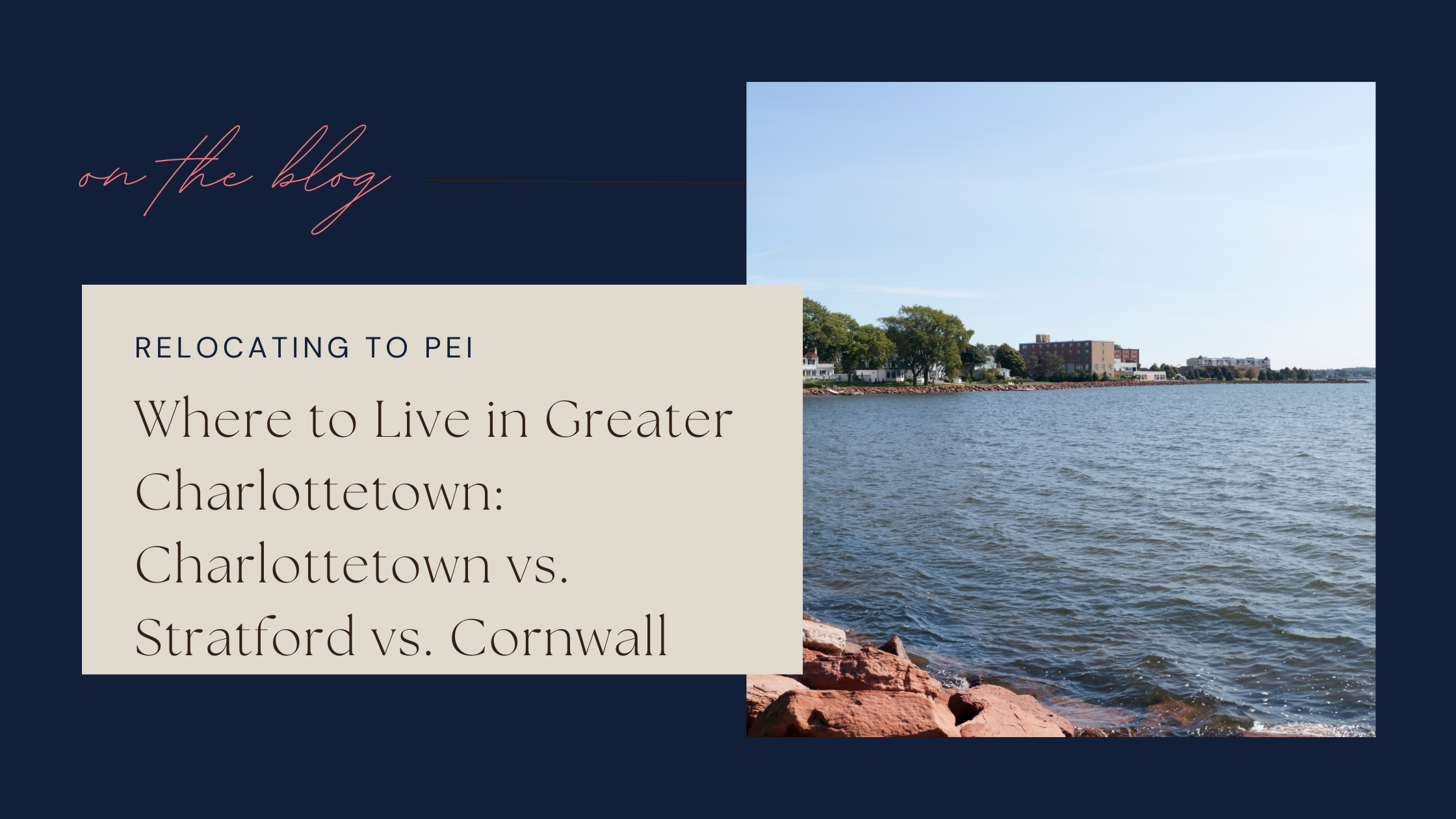
Should I Live in Charlottetown, Stratford, or Cornwall?
Same island, same 15-minute radius, three totally different ways of life. If you're buying in Greater Charlottetown, this is the comparison nobody gives you straight.
If you're house hunting in Greater Charlottetown, you've probably noticed the same three names keep coming up: Charlottetown itself, Stratford, and Cornwall. They're all a stone's throw from each other, but they feel pretty different once you're actually living there. Here's how I'd break it down for a buyer.
Charlottetown: closer to it all, pay for the privilege
Charlottetown is the island's only real city — downtown core, older character homes, tree-lined streets in neighbourhoods like Brighton and Parkdale, and the shortest commute you'll find anywhere on PEI (sometimes zero, if you're downtown).
Worth being honest about: this isn't a walk-everywhere city, even in Charlottetown proper. The core and close-in neighborhoods are walkable for day-to-day stuff, and the city's gotten more bikeable over the last few years — but it's still a work in progress. That's especially true if you're in the outer parts of the city like East Royalty, West Royalty, or Winsloe, where you're driving for most errands just like you would in Stratford or Cornwall.
Good fit if you:
Want the most walkable/bikeable options on the island, even if it's not true everywhere in the city
Like older homes with character (and are comfortable budgeting for the maintenance that comes with them)
Want the shortest possible commute to work downtown or at the hospital
Are looking for lower-cost entry points — Charlottetown has more selection of townhomes, condos, and mobile homes on rented land than Stratford or Cornwall
Trade-offs:
Lots downtown and in the newer subdivisions tend to run smaller, though there are pockets throughout the city with larger-than-expected lots — worth asking about if yard space matters to you
Housing stock skews older, so inspections matter more
Median single-family price as of June 2026: $448,000 — the most affordable of the three, though you're trading some yard space for it
2026 property tax rate (PEI resident, provincial tax credit included): $1.67 per $100 of assessed value
Stratford: newer builds, water views, a short bridge away
Stratford sits just across the Hillsborough River from Charlottetown — a few minutes over the bridge and you're downtown. It's grown a lot over the last decade and has a reputation for newer subdivisions and larger lots. Stratford has also been the more sought-after of the two "across the water" communities for years, and the price gap between Stratford and Cornwall reflects that history — though Cornwall's growth (bypass and all) has been narrowing that gap.
Good fit if you:
Want a newer build within a short drive of downtown (bridge traffic aside)
Like the idea of water proximity — several Stratford neighborhoods back onto the river/harbour
Want more yard space than you'd typically get in Charlottetown proper
Have kids, or plan to — Stratford's Community Campus (a new high school plus sport fields, trails, and a wellness centre) is under development on ~170 acres, with the high school currently under construction
Trade-offs:
Less walkable — you're driving for groceries and errands more often than in the city
Fewer character/older homes if that's what you're after
If you work in Charlottetown, you're crossing the Hillsborough Bridge to get there — and that's a real bottleneck during peak traffic times
Median single-family price as of June 2026: $511,000 — the highest of the three
2026 property tax rate (PEI resident, provincial tax credit included): $2.72 per $100 of assessed value
Cornwall: small-town feel, still close to the city
Cornwall is on the other side of Charlottetown, a bit further out than Stratford but still a manageable commute. It's got a stronger small-town, community feel — good for buyers who want some separation from city life without going full rural.
Cornwall's also seen real growth over the past several years, and a big reason is the Trans-Canada Highway bypass — through-traffic (including truck traffic) now routes around the community instead of through the middle of it. That's made a noticeable difference in how the town feels day to day, and it's part of why more people are looking at Cornwall than they used to.
Good fit if you:
Want a quieter, more small-town vibe — helped along by the highway bypass keeping through-traffic out of town
Are looking at larger lots or acreage-adjacent properties
Don't mind a slightly longer commute in exchange for space and quiet
Trade-offs:
Commute is a bit longer than Stratford's — and Cornwall has its own chokepoint at the North River Causeway, though the roundabouts there tend to keep traffic flowing better than the Hillsborough Bridge does
Less walkable — plan on driving for most day-to-day needs
Some areas may be on well/septic rather than municipal services, which is a bigger factor to plan around than people expect
Shopping options are more limited than what you'll find in Stratford — you'll be driving into Charlottetown or Stratford for a lot of it
Median single-family price as of June 2026: $477,500 — sits between the other two
2026 property tax rate (PEI resident, provincial tax credit included): $2.80 per $100 of assessed value
So which one's right for you?
Honestly — there's no wrong answer here. It comes down to whether you'd rather walk to dinner or have a bigger yard, and how much commute time you're willing to trade for either one. If you want to talk through what fits your day-to-day life, that's exactly the kind of conversation I like having early — before we even start touring houses.
Want a deeper dive on the neighborhoods within Charlottetown itself? Check out my Charlottetown neighborhood guide.
I also sat down for a video discussion on this exact topic — Charlottetown communities and the commutable communities just outside the city. Watch it here.

Prepping a Home to Sell vs. Living In It — The Honest Gap
If you've lived in your house for any length of time, it works for you. The mail pile has a spot. The kids' art is on the fridge. There's a system, even if it doesn't look like one to anyone else.
None of that is wrong. But it's not the same thing as a house that's ready to sell — and I think buyers (and honestly, a lot of sellers) get told the two are basically the same. They're not. Here's the honest gap.
Living in a home is about function. Selling it is about first impressions.
When you live somewhere, your brain fills in the gaps. You don't see the scuff on the baseboard anymore — you know it's there, but it stopped registering years ago. A buyer walking in for the first time doesn't have that filter. They notice everything, in about the first 90 seconds.
That's not a knock on how you keep your house. It's just a different lens.
What "lived in" usually looks like
Furniture arranged for how your family actually uses the space, not for flow
Personal photos, kids' schoolwork, collections — the stuff that makes it yours
A closet that's full because, well, you live there and you have stuff
Maybe a room/space that's become the catch-all (we all have one)
What "ready to sell" usually looks like
Furniture arranged so buyers can picture their own stuff in the space
Fewer personal photos — buyers need to picture themselves there, not you
Closets and storage that look like there's room to spare, even if you have to pack some things early
Every room reads as a room, not a catch-all
Neither version is "better." One is set up for your daily life. The other is set up to sell fast and for the best price. Trying to do both at once is where sellers get stuck.
Decorating for living and decorating to sell are honestly two different jobs. Your decorating style is a reflection of you — but getting your home ready to sell is about making it appeal to the most buyers possible. Same house, completely different goal.
Why this gap catches people off guard
Most sellers don't realize how much prep matters until they're standing in a fully staged version of their own home and thinking, huh, I would've bought this. That reaction is the whole point. It's not about hiding anything — it's about letting the house make its case without your daily life competing for attention.
Getting into a buyer's head
Buyers don't just see clutter — they see a storage problem. A closet packed full doesn't read as "we have a lot of stuff," it reads as "this house doesn't have enough storage." Same with deferred maintenance. A little wear here and there makes a buyer start wondering what else has been put off that they can't see.
None of that may be true. But buyers are making snap judgments with limited information, and it's our job to head off those objections before they even form — not after they've already knocked the price down in their head.
It works the other way too. Walk a buyer into a home with a fresh coat of paint, that smells homey and inviting, and something shifts. They stop noticing the house and start picturing themselves in it — moving their furniture in, hosting people, actually living there. That's the moment you're aiming for.
The honest part
This isn't about spending a fortune or gutting your house. A lot of it is depersonalizing, decluttering, and small fixes that take an afternoon, not a reno budget. But it does take some effort, and it does mean living a little more "staged" for a stretch while your home's on the market.
If your goal is top dollar and a faster sale, closing that gap is worth it. If you're just starting to think about listing, that's exactly the kind of thing we walk through together before your home ever hits the market — including two questions I always ask upfront: how much time do you have to get ready, and what's your budget? Both change what prep actually looks like for you.
At the end of the day, real estate is a trade between time and money. If time matters more to you, you might end up sacrificing a bit on price. If price matters more, you'll need to put in the time (or the budget) to get there. Neither is wrong — it just helps to know which one you're prioritizing before we start.
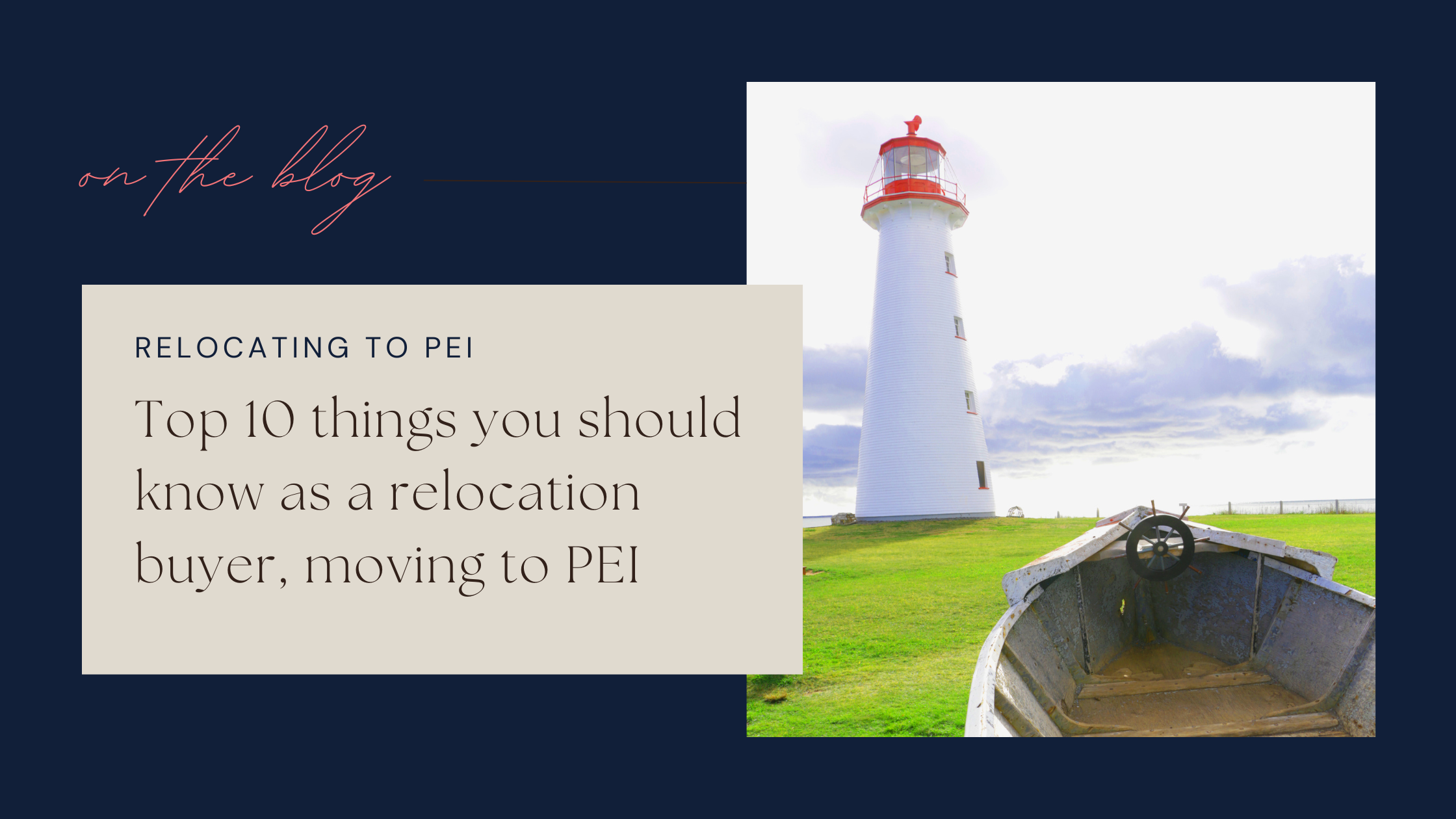
What Do I Need to Know Before Relocating to PEI?
Relocating to PEI comes with a learning curve nobody warns you about. From bridge traffic to mud season, here are 10 things I wish every relocation buyer knew before they made the move.
If you are considering a move to PEI, then there are a few important things that you should know before making the move.
You are never more than 15 minutes from the ocean! ‘Nuf said
Sometimes, having to cross the Hillsborough Bridge is just too far to ask someone to go, especially if it coincides with ‘rush hour’.
When we say it will take 45 minutes to get somewhere, that means that you will be driving for those 45 minutes and the only traffic that you may run in to is farming traffic (unless you are crossing the Hillsborough Bridge at peak traffic times).
Some people will be totally okay with driving an hour to go somewhere - me, that is probably a day trip if I have the kids. Some will think it is absolutely too long to even drive half an hour…unless you are going to Halifax - then 3 hours is nothing!
Everyone knows someone who knows someone. Ask about a house, a contractor, or a person and there's a solid chance the person you're asking is related to them, dated them, or went to high school with their cousin. Word travels fast here — be nice to everybody. I have literally had someone try to tell me we were related because he used to be best friends with my dad’s cousin’s ex-husband.
The red dirt gets on everything. Your shoes, your car, your dog, your kids' pants right after you put clean ones on them. Then mud season hits — that stretch in spring when the frost comes out of the ground and everything turns to soup — and it gets so much worse. Just accept it now and save yourself the fight.
Ferry or bridge, winter will shut them down. If a storm's coming, don't plan anything that depends on leaving the Island that day — just do what every Islander does and grab your storm chips. [If you don't know what storm chips are yet, you will soon]. Also, the ferry doesn’t run at all from December 20th-ish until May 1, so when the bridge closes, the island is CLOSED!
"Just up the road" is a real unit of measurement and it has nothing to do with actual distance. It could be 5 minutes, it could be 20. You'll just have to go with it.
Grocery and big box shopping is more limited than what you're used to — no Costco on-Island, so that's a trip across the bridge (see #4, hello Halifax). Islanders plan their big shops around it. I plan a trip to Hali early December to get a Costco stock up in and do a bunch of holiday shopping.
The pace of life is genuinely slower — and that's the whole point. If you're moving here expecting the conveniences of a city, you're going to be disappointed. If you're moving here for the quiet and the beach 15 minutes away, you picked right.
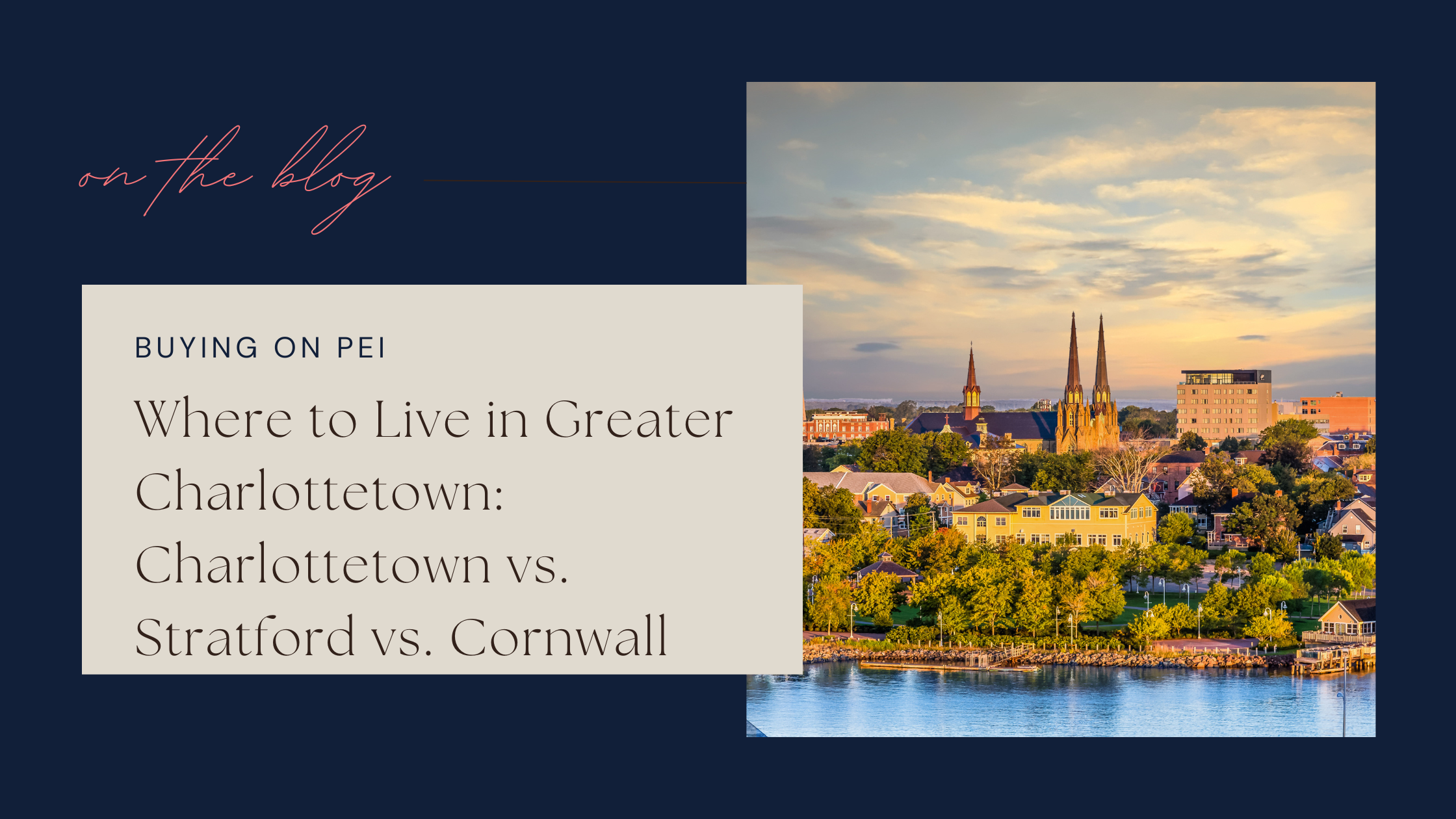
Where to Live in Greater Charlottetown: Charlottetown vs. Stratford vs. Cornwall
Which community should we live in?" is one of the first questions almost every buyer asks me. Here's my real answer — trade-offs, prices, and all.
If you're house hunting in Greater Charlottetown, you've probably noticed the same three names keep coming up: Charlottetown itself, Stratford, and Cornwall. They're all a stone's throw from each other, but they feel pretty different once you're actually living there. Here's how I'd break it down for a buyer.
Charlottetown: closer to it all, pay for the privilege
Charlottetown is the island's only real city — downtown core, older character homes, tree-lined streets in neighborhoods like Brighton and Parkdale, and the shortest commute you'll find anywhere on PEI (sometimes zero, if you're downtown).
Worth being honest about: this isn't a walk-everywhere city, even in Charlottetown proper. The core and close-in neighborhoods are walkable for day-to-day stuff, and the city's gotten more bikeable over the last few years — but it's still a work in progress. That's especially true if you're in the outer parts of the city like East Royalty, West Royalty, or Winsloe, where you're driving for most errands just like you would in Stratford or Cornwall.
Good fit if you:
Want the most walkable/bikeable options on the island, even if it's not true everywhere in the city
Like older homes with character (and are comfortable budgeting for the maintenance that comes with them)
Want the shortest possible commute to work downtown or at the hospital
Trade-offs:
Lots downtown and in the newer subdivisions tend to run smaller, though there are pockets throughout the city with larger-than-expected lots — worth asking about if yard space matters to you
Housing stock skews older, so inspections matter more
Median single-family price as of June 2026: $448,000 — the most affordable of the three, though you're trading some yard space for it
2026 property tax rate (PEI resident, provincial tax credit included): $1.67 per $100 of assessed value
Stratford: newer builds, water views, a short bridge away
Stratford sits just across the Hillsborough River from Charlottetown — a few minutes over the bridge and you're downtown. It's grown a lot over the last decade and has a reputation for newer subdivisions and larger lots.
Good fit if you:
Want a newer build within a short drive of downtown (bridge traffic aside)
Like the idea of water proximity — several Stratford neighborhoods back onto the river
Want more yard space than you'd typically get in Charlottetown proper
Have kids, or plan to — Stratford's Community Campus (a new high school plus sport fields, trails, and a wellness centre) is under development on ~170 acres, with the high school currently under construction
Trade-offs:
Less walkable — you're driving for groceries and errands more often than in the city
Fewer character/older homes if that's what you're after
If you work in Charlottetown, you're crossing the Hillsborough Bridge to get there — and that's a real bottleneck during peak traffic times
Median single-family price as of June 2026: $511,000 — the highest of the three
2026 property tax rate (PEI resident, provincial tax credit included): $2.72 per $100 of assessed value
Cornwall: small-town feel, still close to the city
Cornwall is on the other side of Charlottetown, a bit further out than Stratford but still a manageable commute. It's got a stronger small-town, community feel — good for buyers who want some separation from city life without going full rural.
Cornwall's also seen real growth over the past several years, and a big reason is the Trans-Canada Highway bypass — through-traffic (including truck traffic) now routes around the community instead of through the middle of it. That's made a noticeable difference in how the town feels day to day, and it's part of why more people are looking at Cornwall than they used to.
Good fit if you:
Want a quieter, more small-town vibe — helped along by the highway bypass keeping through-traffic out of town
Are looking at larger lots or acreage-adjacent properties
Don't mind a slightly longer commute in exchange for space and quiet
Trade-offs:
Commute is a bit longer than Stratford's — and Cornwall has its own chokepoint at the North River Causeway, though the roundabouts there tend to keep traffic flowing better than the Hillsborough Bridge does
Less walkable — plan on driving for most day-to-day needs
Some areas may be on well/septic rather than municipal services, which is a bigger factor to plan around than people expect
Median single-family price as of June 2026: $477,500 — sits between the other two
2026 property tax rate (PEI resident, provincial tax credit included): $2.80 per $100 of assessed value
So which one's right for you?
Honestly — it depends on what you're optimizing for:
Walkability and shortest commute → Charlottetown
Newer build, water proximity, still close to downtown → Stratford
Small-town feel, more space, willing to drive a bit more → Cornwall
There's no wrong answer here. It comes down to whether you'd rather walk to dinner or have a bigger yard, and how much commute time you're willing to trade for either one. If you want to talk through what fits your day-to-day life, that's exactly the kind of conversation I like having early — before we even start touring houses.
Want a deeper dive on the neighborhoods within Charlottetown itself? Check out my Charlottetown neighborhood guide.
I also sat down for a video discussion on this exact topic — Charlottetown communities and the commutable communities just outside the city. Watch it here.

Charlottetown Neighbourhoods: Where Should I Buy?
Thinking about where to buy in Charlottetown? A REALTOR's honest breakdown of Brighton, downtown, West Royalty, Winsloe, and more.
One of the questions I get asked more than almost anything else: "Okay, but where should we actually live?" Here's my honest, no-fluff breakdown of the main Charlottetown-area neighborhoods, so you can start narrowing it down.
If you're moving to PEI or buying your first place here, the neighborhood question can feel bigger than the house question. Totally normal. Here is a quick breakdown of the main areas I get asked about most.
Brighton
Brighton is one of Charlottetown's most established, walkable neighborhoods — close proximity to downtown and Victoria Park, with mature lots and classic homes that make it a desirable spot. In 2025, homes here sold in the $600,000–$1,000,000 range.
Schools: Kent Street Elementary, Queen Charlotte Intermediate, Colonel Gray High School.
Good fit if you want in-town living without actually being downtown.
The 500 Block & Downtown Core
This is as central as it gets — walk to restaurants, the waterfront, work, everything. It's a mix of older homes, condos, and some newer build additions. Smaller condos start around $225,000, ranging up to luxury waterfront condos in the high $700,000s. Single-family homes sold for $300,000–$700,000 in 2025. Parking space can come at a premium down here, and the walking and biking lifestyle is often weather-dependent.
Depending on where you land, elementary is either St. Jean's or Prince Street School, both feeding into Queen Charlotte Intermediate and Colonel Gray High School.
Good fit if lifestyle and walkability matter more to you than square footage.
Parkdale, Spring Park & Sherwood
I'm grouping these three together because they tend to come up in the same breath for buyers — very family-friendly, larger yards and homes, neighbourhood parks, and quiet streets good for biking and street hockey. Condo developments (especially around the university) range from $200,000–low $300,000s. Single-family homes range $300,000–$700,000.
Elementary schools: Parkdale Elementary, Spring Park Elementary, Sherwood Elementary — Spring Park and Sherwood are newer builds, both offering French immersion alongside the regular English track. Parkdale and Sherwood feed into Stonepark Intermediate, then Charlottetown Rural High School. Spring Park feeds into Queen Charlotte Intermediate, then Colonel Gray High School.
Good fit for buyers who want an established neighborhood feel without being brand new construction.
West Royalty & Winsloe
West Royalty covers a good chunk of newer development on the edge of the city, with a mix of subdivisions at different price points. Winsloe sits right alongside it — a bit more rural feel, generally larger lots. Lower-priced homes in this area are in Meadowvale Park, a rented-land community in Miltonvale, running $165,000–$270,000. Single-family homes are a mix of semi-detached and detached, ranging $300,000–$1,000,000+. School is West Royalty Elementary, with a French immersion option at Spring Park, then Queen Charlotte Intermediate and Colonel Gray High School. Commute to downtown runs about 15–20 minutes, depending on traffic and weather.
Standout pocket: Lewis Point. Larger, luxury homes on larger lots, many with water views or water frontage. Homes here run $600,000–$1,000,000.
Good fit for buyers wanting newer construction with more room to grow, or a bit more breathing room without a long drive into the city.
Hillsborough & East Royalty
Grouping these together as well — both sit on the east side, with a mix of established and newer housing stock. Two rented-land communities here — Parkwood Estates and River Ridge Estates — with properties selling $155,000–$300,000. Condos sold $200,000–almost $400,000. Single-family homes (a mix of semi-detached and detached) ranged $215,000–$820,000. Schools: L.M. Montgomery Elementary, Stonepark Intermediate, then Charlottetown Rural High School. Commute to downtown runs about 15–20 minutes, depending on traffic and weather.
Good fit for buyers who want east-side convenience with some variety in home age and style.
So... where should you buy?
Honestly? It depends on your lifestyle, family needs, your budget, and what you actually want your day-to-day to look like — not just what looks good on paper. That's the conversation we have in your onboarding consultation, and it's a big part of why I don't just hand people a listing sheet and call it a day.
If you're just starting to figure this out, these might help too:
Want to talk through which neighborhood actually fits your life? Reach out anytime.
All price figures reflect 2025 sales data and are subject to change.
Chat soon! Amy

The Hidden Costs of Buying a Home in PEI (Beyond the Down Payment)
Budgeting for a home purchase on PEI? Inspections, land transfer tax, IRAC approval for larger or waterfront properties, and the fuel tank adjustment can all add up fast. Here's what to expect before closing day.
If you're buying a home [check out our buyer services page] in Charlottetown — or anywhere on PEI — you've probably done the math on your down payment, maybe priced out a moving truck, and figured you had your budget covered. Then a few days before closing, your lawyer sends over a document with a handful of line items you've never heard of, and suddenly you're wondering if you have enough cash to actually close.
This happens to almost everyone. So let's go through it before you're staring at that document wondering what half of it means.
Inspections
The total cost of the inspection can vary depending on the size of the home but generally right now, this is the cost of a full home inspection. In addition to the home inspection, if the property is rural and not on municipal sewer, a septic inspection is a good idea.
Home inspection: around $700
Septic inspection (if the property's on a septic system): around $700
These aren't legally required, but I push for them every time. A few hundred dollars now is a lot cheaper than finding out about a furnace has an air lock — or a failing septic field — after you already own it.
Land Transfer Tax
If you're not a first-time buyer, PEI charges a land transfer tax of 1% of the purchase price. First-time buyers are exempt — so if this is your first home, cross this one off your worry list. [Worth double-checking the exemption qualifiers haven't changed before this goes live.]
This one's worth flagging early, because on a $450,000 home, 1% is $4,500. It's not a small number, and it's not optional if you've owned property before.
IRAC Approval for Out-of-Province Buyers
This one's specific to relocation buyers, and it catches people by surprise. If you're not a PEI resident and you're buying 5+ acres or 165+ feet of waterfront frontage, the purchase needs approval from the Island Regulatory and Appeals Commission (IRAC).
That approval comes with its own cost: 1% of the purchase price, plus roughly $1,500–$2,000 in additional legal fees to handle the application. This is a range as it can vary depending on the law firm but when I spoke with several different lawyers at the beginning of 2026, they all fell in that range.
If you're moving to PEI from away and have your eye on a larger property or a place with real water frontage, this is a cost to ask about early — not something to discover after you're already under contract. In fact, it can be a determining factor if your offer on a property is accepted so it cannot be something that is added later as the IRAC application greatly effects the timeline of the transaction as well.
The Fuel Adjustment
Here's one that surprises a lot of buyers: on PEI, it's standard practice to buy a property with the fuel tanks full. That's actually the fair way to do it — full tanks are the only way for anyone to know exactly how much fuel is being purchased, instead of guessing at what's left. So at closing, you reimburse the seller for the cost of that fuel at the closing day’s current fuel price.
This can add up more than people expect, especially if the home has both an oil tank and propane tanks. [Personal experience talking here — I had one oil tank and two propane tanks on my last home purchase, and that adjustment was not small.] It's not a hidden fee exactly, but it's also not something most buyers think to budget for until they see it on the statement.
If you're buying a home heated by oil or propane, ask your REALTOR® early what heating system the property uses — it changes how much cash you'll need on hand at closing.
Statement of Adjustments (this is the one nobody explains)
When your lawyer finalizes the deal, they prepare what's called a Statement of Adjustments — basically the math that splits costs fairly between you and the seller based on the exact closing date. The other pieces that show up most often:
Land transfer tax — calculated right into this statement, if it applies to you
Title insurance — protects you against title issues that didn't turn up in the lawyer's search
Legal fees — your lawyer's fee for handling the closing
Deed registration — the cost to register the deed with the province
Mortgage registration — the cost to register your mortgage, if you're financing
Title search — checking the property's legal history
Real estate disbursements — small admin costs like document production and registry copies
HST on the taxable items above
None of these are PEI-specific scams or hidden fees — they're just standard parts of any property closing in the province, bundled into one document so your lawyer can show you exactly what you owe and what you're getting back.
How Much Should You Actually Budget?
There's no single number that fits every purchase — it depends on the purchase price, whether you're a first-time buyer, whether IRAC approval applies, and what the home is heated with. That's exactly why this document exists: to give you the real number for your specific deal before you're standing at the lawyer's office.
The best move is to ask your lawyer for an estimated Statement of Adjustments as soon as you're a few weeks out from closing, so there are no surprises on closing day.
Why this matters
None of this is hidden on purpose — it's just not necessarily the stuff that gets talked about when you're house hunting. Your lawyer will walk you through the actual numbers on your Statement of Adjustments before closing, and I always tell buyers to ask questions on anything that doesn't make sense. There's no dumb questions on closing day.
If you're working through your own first-time buyer budget, check out my First-Time Buyer Tips.
And if you're relocating to PEI and want the full picture before you move, here's my guide to buying from out of province.
Quick FAQ
Do I have to get a home inspection in PEI?
No, it's not legally required, but it's strongly recommended — especially on older homes or anything with a well or septic system.
Is land transfer tax the same for everyone?
No — first-time buyers in PEI are exempt. Everyone else pays 1% of the purchase price.
What is IRAC approval and who needs it?
Non-resident buyers purchasing 5+ acres or 165+ feet of waterfrontage need approval from PEI's Island Regulatory and Appeals Commission, which adds 1% of the purchase price plus roughly $1,500–$2,000 in legal fees on top of standard closing costs. To be considered a resident of PEI, you must have resided full-time in the province for 12 of the past 24 months.
Why do I have to pay for fuel that's already in the tank?
Because the tank comes full at closing — it's the standard, fair way to handle fuel costs on PEI, since a full tank is the only way to know exactly how much fuel is being transferred. The seller ensures that the tank is full just before closing and then you pay for a full tank. They provide a receipt to their lawyer proving that they had the tank topped up. As the buyers agent, we also ensure that the tank is full at our final walk through.

The Real Estate Dream
Sometimes, it pays off to listen to your parents and the advice they give.
When I was in my early twenties, I remember one specific nugget of advice that my dad gave me (there were lots but this one really stuck with me).
“If I could do it again, for our first house, I would have bought a duplex.”
Here is a man who has put himself through university, got a job, bought a cheap house in the country, fixed it up while working full time and raising his young family and has been moving his way up in houses over the years. The house they were living in at the time was a wonderfully comfortable, family home more than large enough for all of us. And still, he had a thought about how he could have done something better. And it stuck with me.
When Tyler and I talked about buying our first home, this long remembered piece of advice was discussed and we decided that yeah, buying a duplex for our first home WAS a great idea. We could live in half, charge rent for the other half and essentially live almost rent free. So we did.
As we searched, for each property that we looked at, we evaluated the price, the rent numbers, the bills, etc. We had a spreadsheet that gave an extrapolated income versus expenses for each property (we were both in our nerd element here) - we needed to know that we could cover the expenses of the property for several months without any rental income coming in. In the end, we only looked at 5 or 6 properties before we made an offer. and we were ready to jump at the property when we found it because we had been doing our homework.

And so we did it - we jumped at the opportunity to buy our first property. Four year later, we did sell it when we were expecting our third kiddo. Today, I joke that we traded our investment property for a minivan, and we wouldn’t have it any other way.

What Should I Expect When Working With a REALTOR®️ in PEI?
A straightforward guide to working with a real estate agent in Charlottetown and across PEI — covering commission, timelines, and what buyers and sellers should expect at every step.
If you're thinking about buying or selling a property on PEI and you're weighing your options for who to work with — this one's for you.
Working with a real estate agent should make the process easier, not more confusing. But if you've never done it before (or you've had a frustrating experience in the past), you might not know what "good" actually looks like. Here's my honest breakdown of what you should expect.
First Things First: What Does an Agent Actually Cost?
This is the question we get asked most often — and the answer surprises a lot of people.
On PEI, commission is paid by the seller, not the buyer. It's typically 4–5% of the purchase price, plus HST, and it's usually split equally between the selling agent and the buying agent.
Many agents like to say that it doesn’t cost the buyer anything to work with an agent but that’s not exactly true. You are spending hundreds of thousands of dollars so of course it is costing you something. Here's the nuance: The commission is built into the purchase price of the property — so in a roundabout way, it's factored into what you're paying. But you won't [usually] write a separate cheque to your agent at the end of the deal. That cost is [usually] handled through the seller's proceeds.
What this means practically: as a buyer, you should absolutely have your own agent representing you. There's no reason not to — and a good one will help you more than anything else.
What Happens Before You Even See a Property (Or List One)
Here's something we wish more clients knew before their first call: the work you do upfront makes the process easier later.
If you're buying:
Get a mortgage pre-approval before you start seriously looking. This isn't just a box to check — it tells you your actual budget, speeds up the offer process, and signals to sellers that you're a serious buyer. In a competitive market, it can be the difference between getting the house and missing it. There are a number of factors that get worked into the numbers to determine your purchasing power: income, debt, property taxes, heat/electricity costs, dependents, etc - the list goes on. So checking this box ahead of time can alleviate a lot of stress down the road.
If you're selling:
Take more time than you think you need to prepare the property before it goes live. We know that sounds counter-intuitive when you're eager to get moving — but properties that are properly prepared sell with less stress, fewer surprises, and usually better results. We'll tell you honestly what's worth doing and what isn't.
What Does Having Your Own Agent Actually Mean?
There's a difference between an agent who opens doors and an agent who actually knows you.
When we take on a buyer or seller as a client, we want to understand what you're looking for — not just the number of bedrooms, but the life you're wanting to build. That context matters. It's what helps us flag the right property, ask the right questions, and guide you through decisions that sometimes have to be made quickly.
You are not just a transaction to us. We're here for the individual and family — and that means your agent should be someone you can actually talk to, who picks up the phone, and who tells you the truth even when it's not what you were hoping to hear.
We work with many clients who are coming to PEI to build their island dream. If you're moving to the Island from out of province, relocating to PEI comes with its own questions — and buying a home from out of province is something we walk clients through often - from choosing a community, finding the home, and making sure everything is ready for them to start living their island dreams.
What the Process Actually Looks Like (Step by Step)
Every deal is a little different, but here's a general picture of what to expect:
For buyers:
Initial conversation — we get to know what you're looking for and where you're at financially
Mortgage pre-approval (if not already done)
Property search and showings
Offer preparation and negotiation
Conditions period — inspection, financing, insurance, title
Pre-closing walkthrough
Closing day 🎉
For sellers:
Initial consultation — we walk the property, talk pricing and timing
Preparation phase — pre-packing, staging, photography, any recommended updates
Listing goes live
Showings and open houses
Offer review and negotiation
Conditions period
Closing
Throughout all of it, your agent should be the one keeping track of deadlines, flagging what's coming next, and making sure nothing falls through the cracks.
What Good Communication Looks Like
You should never feel like you're waiting and wondering. A good agent keeps you informed — not with a flood of updates, but with the right information at the right time.
We're big believers in explaining the why behind every step. Not just "you need to sign this form" but "here's what this form is, why it exists, and what happens next." The process has a lot of moving parts, and our job is to make sure you always know where you are in it.
Ultimately, every decision is yours to make. We'll give you our honest read — and then we'll give you the space to think it through. [We're not going to push you into anything. That's just not how we work.]
The Bottom Line
Working with a real estate agent in Charlottetown should feel like having someone genuinely in your corner — someone who knows the process, knows the market, and actually knows you.
If you're comparing agents right now and trying to figure out who to work with [check out my “10 questions to ask a REALTOR®️ during the Consultation process“ blog], here's our honest advice: find someone you can talk to. Someone who asks good questions, gives you straight answers, and doesn't make you feel like a number.
That's what we try to do at Blue Door Properties.
Have questions about buying or selling on PEI? Reach out — we're happy to chat before you're ready to commit to anything.

Relocating to PEI: Everything You Need to Know About Buying a Home Here
Buying on PEI works a little differently than wherever you're coming from. From dual agency to IRAC to why that tax number on realtor.ca is almost definitely wrong — here's the plain-English breakdown for out-of-province buyers.
What You Need to Know Before Buying on PEI
This blog is repurposed from a live discussion from the Facebook group Move to PEI. The recording of the live disucssion can be viewed here.
So you're thinking about making the move to Prince Edward Island. Maybe you've been lurking in our Facebook group for a while, saving posts, daydreaming about red sand beaches and a slower pace of life. Maybe you've already got a timeline. Either way, at some point the daydream turns into a plan — and that's when the questions start.
One of the biggest ones we hear is: how does buying here actually work?
And the honest answer is: a little differently than wherever you're coming from. PEI has its own rules, its own quirks, and its own market behaviour. Some of it will surprise you. Some of it will be a relief. All of it is worth knowing before you start.
So grab a coffee. Here's the breakdown.
Finding the Right Agent — and Why It Really Matters
Let's start here, because everything else flows from this.
When you're buying on PEI — especially from away — your agent should be doing a lot more than opening doors. They're your eyes on the ground. They're the one showing up to your inspection, asking the questions you didn't think to ask, noticing that the oil tank is original or the roof is closer to the end of its life than the listing suggests.
If you're not on the island yet, we'll often do video walkthroughs — full tours of a property, narrated, so you're seeing the gutters and the basement and the water heater, in addition to the pretty kitchen. We've built private YouTube playlists for out-of-province clients so they can go back and watch multiple properties side by side without their brains turning to mush. [And trust us, after five showings in a day, your brain starts to go a bit mushy.] WeTransfer works for big files when YouTube isn't the right fit. There are options.
The point is: distance doesn't have to be a dealbreaker. But you do need someone who actually shows up for every step of the process — virtually or in-person. That's exactly what our relocation services are built around.
One thing PEI still has that some provinces have moved away from is dual agency. That means the listing agent — the agent who represents the seller — can also represent you as the buyer. It's legal here. But it comes with real trade-offs that are worth understanding before you assume it's fine.
When an agent is representing both sides, they're legally required to sit in the middle. They can't negotiate for you. They can't tell you whether the seller would take less, or push back on something in the inspection, or advocate for your position at the table. They can push papers from one side to the other, and that's about it. If you're a confident, experienced buyer who is here in person and wants a transaction handled cleanly, maybe that's fine. But if this is your first time buying here, or you want someone actually in your corner? Get your own representation. It changes the whole experience. And I know Brooke and I wouldn’t balk at you saying to us that you want your own agent - we totally get it! Check out what it looks like to work with us for buying…
Multiple Offers — What Actually Happens
The spring market on PEI moves. And when inventory is tight and a good property comes up, multiple offers happen.
Here's how it works here, because it's a bit different from what you might have experienced elsewhere.
When a second offer comes in on a property you've already offered on, the listing agent is required to notify you. You get the opportunity to revise your offer — once. That revision is your final and best offer. There's no second kick at the can, no back-and-forth. You put forward what you're putting forward, and then the seller picks.
The thing we always tell our clients: you never find out what the other offer says. Not the price, not the conditions, not the closing date. Nothing. That information is confidential, and it stays that way. What your realtor can do is ask the right questions — things like whether a particular closing date would work better for the seller, or whether there's flexibility on something specific. There's information you can gather without crossing any lines. A good agent knows how to do that.
What we also tell clients: this is not a competition. The goal isn't to win. The goal is to feel good about what you've offered for a property you actually want to live in. Some people get competitive, and that's human — but overbidding on a house just because another offer showed up is a fast way to feel buyer's remorse on closing day. Offer what you're genuinely comfortable with. And if it doesn't work out, there will be another house.
That said, price isn't the only lever. Flexible closing dates, fewer conditions, creative structuring — all of these can make your offer more appealing without necessarily costing you more money.
SOBP — The Selling-While-Buying Scenario
If you own a home where you are right now and you need to sell it before you can buy here, that's what we call a Sale of Buyer's Property condition — SOBP for short. It's one of the most common scenarios we work with for out-of-province buyers, and it's worth understanding in some detail.
Here's how it plays out: you come to the island, you find a property you love, and you want to make an offer — but the purchase of the house you want is conditional on your house back home selling first. That condition goes into your offer to purchase. The sellers know what they're agreeing to. We'll still work through the other conditions — inspection, financing, insurance, septic if it's a rural property — within the typical two-week window but that SOBP clause stays open while you're actively working to sell, often for a month to start.
The ideal version of this looks like: your house back home is already listed, it's priced right, and the market is moving. Things are happening in parallel. You close on yours, you firm up on theirs, everyone moves on a coordinated timeline. [Yes, it can feel like a very high-stakes game of Tetris. That's accurate.]
The trickier version is when things stall. Your house isn't selling as fast as expected. The price might need adjusting and you might need to ask for an extension on the SOBP clause. And this is where communication between everyone involved — us, the listing agent on the PEI side, your agent back home — really matters. Everyone has to be pulling in the same direction.
Here's the part every buyer with an SOBP clause needs to know: there's something called an escape clause. If another buyer comes along with a clean offer — one that doesn't have an SOBP condition — the seller can activate that clause. What that means for you is you get a short window (typically a few days) to decide whether you can drop your SOBP condition and firm up the purchase, or whether you have to step aside.
We call it having your offer being "bumped," and it can be as stressful as it sounds. You may or may not be in a position to make that call, depending on where things stand with your sale back home and your personal financial position. There's no perfect answer — just being prepared for the possibility so it doesn't catch you completely off guard.
The lower-stress version of all this, if you can swing it, is to sell first and then buy. Clients who come to us already sold have a noticeably different energy. That weight is off their shoulders. They can make decisions from a position of clarity rather than contingency. If that's an option for you — even if it means a rental in the middle — it's worth considering.
Deposits — Smaller Than You'd Think
If you're coming from Ontario, the deposit conversation might feel a little anticlimactic.
PEI deposits are generally modest. For a $400,000 property, it's common to see something in the $2,000 to $10,000 range. On higher-end properties or in higher-stakes situations, deposits can go higher — we've had a $30,000 deposit on a property over a million — but the massive deposit requirements you might have encountered in Toronto or Vancouver are not the norm here.
You typically have 48 hours to a week to send the deposit after an accepted offer, usually by e-transfer. If the deposit is on the larger side, we'll often write in more time to account for daily transfer limits.
Assessments and Taxes — This One Trips People Up
This is probably the piece of information that causes the most confusion for buyers coming from away, so let's spend some time on it.
When you look at a listing on realtor.ca, you'll see a tax figure. And sometimes that tax figure looks really, really low for the price of the property. Almost suspiciously low. We've had buyers wonder if we were pulling a fast one on them. We were not.
Here's what's actually happening: property tax assessments in PEI are based on the last sale price of the property. If a home sold in 1988 for $95,000 and hasn't changed hands since, the assessment is based on that number. It has nothing to do with what the property is worth today. So when you see a $400,000 property with $1,200 in annual taxes, that's why. It hasn't sold since before the internet existed.
What happens when you buy it is that it gets reassessed. And that reassessment is based on your purchase price. Based on what we've been tracking:
Resale properties tend to reassess at roughly 60–70% of the purchase price
New builds are coming in closer to 85% of the purchase price
[I need you to know that this is not a hard and fast rule! The numbers above are just an estimation based on what I have seen with other properties in the past. ]
That's a meaningful difference. If you're buying a new build in Charlottetown in the $400,000 range, you're likely looking at around $6,000 a year in property taxes. If you're looking at a resale property in the same price range, it'll be lower — but still significantly higher than what you see on the listing. Plan accordingly.
New builds that have never sold also won't have any tax figure listed at all, because they've never been assessed. Same principle applies — that number will come after closing.
When we're working with buyers, especially in neighbourhoods where we know the assessed values have recently updated, we'll look at comparable properties to give you a realistic picture of what to expect. It's not an exact science, but you shouldn't be walking into closing blindsided by a tax bill you weren't prepared for.
Water, Wells, and the Poop Talk (Septic)
Okay, this section covers some unglamorous but genuinely important stuff.
Where does your water come from?
On PEI, there are three possibilities:
Municipal water is exactly what it sounds like — city water, connected to a municipal system. If you're in Charlottetown, Summerside, or Montague, this is likely what you're dealing with. It comes with a bi-monthly water and sewage bill, which tends to run around $150 every two months depending on your usage.
A private well means the property has its own water source on the land. When you're buying a property with a private well, the seller is required to have it tested by a third party before closing — a plumber or another qualified professional, not the next-door neighbour. The samples get sent to the province for testing, which is free. If the results come back with any issues — coliform bacteria being a common one — then we can ask for the sellers to fix it, qhether that means shocking the well, installing a UV filter, or installing a sediment filter.
Community wells are less common but do exist in certain areas — places like Victoria, McMillan Point, and parts of Rustico. These are tested on a regular schedule, records are available, and remediation costs fall on the community, not the individual homeowner. If you're looking at a property in one of these areas, it's worth asking about.
And then there's septic.
If a property is not connected to municipal sewer, it has a septic system — a tank and a leach field. As the buyer, you're responsible for arranging and paying for the septic inspection, which currently runs about $700. That includes someone coming out, inspecting the tank, pumping it, and taking away the contents. [Yes, you are paying to remove someone else's waste. We know. We agree. It's a little backwards.]
In Nova Scotia, this cost falls on the sellers. Here in PEI, it falls on you. It is what it is.
There are also holding tanks — essentially just tanks with no leach field. These are older and not commonly used in new builds, but they do exist, often grandfathered into older rural properties. The practical reality of a holding tank is that it needs to be pumped far more frequently (think every six months or so) and you have to be mindful of water usage. If you come across a property with one, just go in with eyes open.
IRAC — The Elephant in the Room
If you've spent any time in our community group, you've probably seen IRAC come up. It's the Island Regulatory and Appeals Commission, and it's the body that reviews and approves real estate purchases when certain thresholds are crossed.
Specifically, you'll need to go through IRAC if you're buying:
5 acres or more of land, or
165 feet or more of waterfront
Unless — and this is the key part — you've lived in PEI for 12 consecutive months out of the last 24. Establish residency, and the IRAC requirement goes away for standard purchases.
Why does this matter? Because the IRAC process adds time, money, and uncertainty to a purchase. You're looking at roughly 1–2 months added to your closing timeline, plus 1% of the purchase price in fees, plus $1,500–$2,000 in additional lawyer costs. And the outcome isn't guaranteed — it's at the discretion of the commission.
A lot of people moving here choose to rent for their first year specifically to sidestep this. You come, you get settled, you figure out which part of the island actually fits your lifestyle (this matters more than people expect), you find your people, get your ducks in a row — and then you buy. By the time you're ready, IRAC isn't a factor anymore.
If you're not interested in more than 5 acres and you don't need 165 feet of waterfront, you can skip all of this entirely and buy right away. But if a chunk of land or waterfront frontage is part of the dream, just factor IRAC into your timeline and your budget from the start.
Down Payment Assistance — Worth Knowing About
PEI has a Down Payment Assistance Program that doesn't get talked about enough.
If you're moving here from a major Canadian city, you might be in a situation where a down payment just hasn't been possible. Housing costs in Toronto, Vancouver, Calgary — they've made saving feel like an exercise in futility for a lot of people. This program exists for exactly that situation.
Here's how it works: the province will cover up to $17,500 toward your down payment (that's 5% of the purchase price) if you qualify. There are some conditions:
Purchase price must be under $350,000
Household income must be under $110,000
You can't have other savings options available (RRSPs, TFSAs, the First Home Savings Account)
You need to have employment set up on the island — not just a plan, but actual income or a confirmed employment letter
The program is available to people moving here, not just existing residents. And there's also a closing cost assistance program for first-time buyers that's worth looking into alongside this one.
If any of this sounds like it might apply to you, flag it early with your mortgage broker or lender. These programs have application steps and the earlier you're in the loop, the better. More information is available here.
When to Buy — and When Not to Stress About It
The PEI market has a rhythm.
The active season typically runs April through early August — that's when listings come out, buyers are motivated, and things move quickly. Multiple offer situations are more common in this window. If you're buying in the spring, come prepared.
Things tend to quiet down in mid-August. Sellers and buyers alike want to soak up the last of the summer before school starts and the season shifts. The market slows a bit, and that's not a bad thing if you're a buyer.
Then there's a fall bump — usually mid-September through early December — where activity picks back up.
And then January through March is quieter, though not dead. There's a lot of prep-work happening behind the scenes — sellers getting ready to list, buyers getting pre-approved, agents having a lot of "okay, when are we doing this?" conversations.
Here's what we'd say about off-season buying: there's a real argument for it. The people who are still listed in November genuinely want to sell. The competition from other buyers is lower. Your negotiating position is stronger. If you're flexible on timing, buying outside the peak season is worth considering.
That said, inventory on PEI has been tighter than expected recently, and that affects all seasons. The market here is smaller than what most out-of-province buyers are used to. There isn't always a huge pool to choose from. Being patient, staying in communication with your agent, and not waiting for a "perfect" moment is generally better advice than holding out for ideal conditions.
One Last Thing
Wherever you are in this process — just starting to think about it, actively searching, or somewhere in the middle — make sure the people you're working with are actually working for you. That means clear communication, honest answers, and someone who's going to tell you what you need to know, not just what you want to hear.
PEI is a genuinely wonderful place to land. The pace, the community, the land, the coastline — people move here and they stay, and they're glad they did. We see it all the time.
If you have questions about any of this, drop them in the comments or send us a message. This is exactly what we're here for.

Your Questions Answered: Moving to Prince Edward Island
Moving to Prince Edward Island comes with plenty of questions — and healthcare is almost always at the top of the list. In this community Q&A, Amy Palmer from the Move to PEI Facebook group walks through the practical side of island life: how to navigate the provincial patient registry, what to do if you're seeing a specialist back home, where to find $10/day daycare, and why securing a rental from out of province is very doable — just requires a little caution. Whether you're comparing Charlottetown to Summerside or bracing yourself for your first island winter, this is the honest, local perspective you won't find in a tourism brochure.
Whether you're curious about navigating the healthcare system, finding affordable daycare, understanding private school options, or locking down a rental from afar, here are the most common questions we hear from people planning a move to PEI — along with honest, practical answers.
This blog post was taken from the live discussion which can be listened to here
Healthcare on PEI
Healthcare is by far the most common concern we hear from people considering a move to the island. Like much of Canada, finding a family doctor here takes some patience — but there are systems in place to help. There really are no tricks, it’s not about who you know - it’s just about time and sometimes some luck.
The first step is to register with the provincial patient registry. When a doctor has openings in their practice, they draw from this list. It's not instant, but it's the only starting point.
Moving tip: Renew your prescriptions before you leave - Before your move, get all prescriptions refilled for the coming year and transferred to a pharmacy near your new home. This buys you time to get to know the local system without running out of medication.
If you're currently seeing a specialist — a cardiologist, neurologist, paediatrician — ask them to send a referral to a counterpart on PEI before you move. This can help keep your care continuous and avoids re-entering waiting lists from scratch.
A few things worth knowing: cardiac cases are typically referred to Saint John, NB, and neurosurgical consultations go to Moncton. PEI does have a neurologist, but not a neurosurgeon. I have had a neurosurgeon in Moncton for 3 years now while I have been waiting for my referral to make it to the top of the pile in PEI to see the neurologist (still in May 2026). This is simply part of how healthcare is organized for smaller provinces.
Daycare and the $10/Day Program
PEI participates in the national $10/day childcare program. To access this rate, you'll need a spot at a provincially registered childcare centre. Home-based or unregistered providers typically won't offer the subsidized rate. The typical daily rate for child care in a home-based day care is around $35/day, from what I have heard.
If you have a space at one of the registered centres, the subsidy goes directly to the centre, and you simply pay $10 per day. The waitlists can be competitive in some areas, so it's worth getting your name in early — before you even arrive, if possible. If you put your name on the provincial registry for day care, you must log on ONCE A MONTH to keep your registry active! VERY IMPORTANT!!!!!
For after-school care, you can expect to pay around $15/day/child/. For summer/PD/March Break camp costs, you can expect to pay $35+/day/child and those fees do not include meals.
Private Schools on PEI
PEI's public school system is generally strong and consistent — there really isn't a "bad" school to avoid. But if you're looking for private options, here's what's available, primarily in the Charlottetown area:
Grace Christian School
Faith-based, to Grade 9+
Emmanuel Christian School
Faith-based, to Grade 9+
Great Wisdom School
Buddhist Institute
Moonlight International Academy
Buddhist Institute
The Mount Academy
Athletics-focused, growing campus
Island Montessori Academy
Toddler–preschool; Cornwall & Stratford
The Mount Academy is a newer and exciting option, with a major building expansion underway at the old Mount Edward Road nunnery. Island Montessori operates two campuses but currently offers programs only up to the preschool level.
Renting from Out of Province
Securing a rental while you're still living elsewhere is one of the trickier parts of the move. The good news: the rental market has loosened up a bit compared to a few years ago, when listings would attract hundreds of applicants within days.
The bad news: rental scams have made there way here as well. Never send a deposit to someone you haven't verified. At minimum, insist on a video call — if someone won't show their face, that's a serious red flag. If you're unsure whether a listing is legitimate, send us a message in the Move to PEI group and we'll help you look into it. If a rental sounds too good to be true, then it probably is.
IRAC — your renter's reference pointThe Island Regulatory and Appeals Commission (IRAC) sets allowable rent increases on PEI and also regulates electricity, heating fuel, and insurance rates. It's a useful resource if you have questions about your rights as a tenant. (link)
Visiting in-person before committing is still the most reliable approach. We recently helped a family from Ontario secure a rental during a visit — they're moving in just six weeks. It can absolutely be done.
Our usual recommendation to avoid being scammed in a rental scam is to go through a reputable rental company. But this does mean that you may not score one of the less expensive rentals. But, you can be confident that the rental you secured will be here waiting for you when you arrive.
Charlottetown vs. Summerside vs. Rural PEI
Summerside is about 30 minutes west of Charlottetown and offers many of the same amenities — Sobeys, Superstore, Canadian Tire, Staples, a movie theatre, and good restaurants. Property prices there tend to run roughly 20% lower than comparable homes in Charlottetown.
Summerside also runs its own electrical grid (separate from Maritime Electric) and has historically sourced a meaningful portion of its power from renewable energy (last stat I read was 35% of the energy comes from a renewable source). One fun perk for the drive between the cities: the PEI Hand Pie Company is right along the highway.
For those considering more rural areas — Mount Stewart, Souris, O'Leary, and beyond — keep in mind that distances on PEI are real distances. A 30-minute drive here means 30 uninterrupted minutes on the road, not 30 minutes stop-and-go through city traffic. Factor in fuel costs and access to services when deciding where to settle. It can also mean that 30 minutes of summer driving might be an hour of winter driving.
Winters on PEI
Yes, it gets cold — and yes, it gets windy. PEI is a small island with relatively few trees and a lot of open farmland, which means wind off the Gulf of St. Lawrence and the Atlantic can feel quite sharp. The north and east shores tend to be the coldest and windiest, while the south shore (along the Northumberland Strait) is somewhat more sheltered.
Most homes now use heat pumps as their primary heat source. This past winter was longer and colder than recent years, which pushed energy bills higher for many households. Budgeting for higher heating costs in a colder-than-average winter is wise. Oil is also a common source of fuel for heating which, in this economy, can be costly - take it from me, someone who has an oil furnace.
That said, winter here has real charm. Cross-country ski tracks get groomed around Charlottetown's Belvedere Golf Course. Snowshoeing on golf courses is popular. The key is dressing well — good layers, proper mittens, a hat — and leaning into the season rather than fighting it. As Brooke likes to say, there is no bad weather, only bad preparation for the weather!
Have more questions? Join the conversation in the Move to PEI Facebook group. We do regular live Q&A sessions and the community is full of people who have made this move and are happy to share what they've learned. PEI is a wonderful place to put down roots — we're glad you're considering it. (link)
Should You Rent First or Buy Right Away on PEI?
Moving to PEI is genuinely exciting — but it's also a big decision. Before you commit to a property, it's worth asking: do you really know which community is right for you? Renting first can be the smartest move you make, giving you time to get to know the island without the pressure of a $400,000 decision. But buying right away makes perfect sense too, if you're ready. Here's our honest breakdown of both paths.
A frank guide to making the right move — literally — when you're relocating to Prince Edward Island.
One of the first questions we hear from people planning a move to PEI is: "Should I rent for a bit, or just go ahead and buy?" And even if we don’t hear the question, I’m sure many of you are wondering it. The answer isn't one-size-fits-all — it depends on your timeline, your lifestyle, your budget, and honestly, how adventurous you are. Here's our honest breakdown of both paths.
The case for renting first
If you've never spent significant time on the island, renting before buying is often the smartest move you can make. PEI is genuinely wonderful — but it's also genuinely different. The pace, the winters, the community culture, the distance from certain amenities: none of that shows up in Instagram photos. Renting gives you a low-stakes window to decide if this really is the place for you.
We've seen it go both ways. Some people arrive, rent for a year, fall completely in love, and never leave. Others discover the island isn't quite what they imagined and are grateful they didn't sink $400,000 into a property first. Both outcomes are perfectly valid. I, myself, have thought I was way more adventurous with my first teaching position than I actually was. When I first accepted my role at Rainbow Lake School in 2011, I was sure that I would be there for years! But it wasn’t the school or town for me and I only stayed a few months before I packed up my Ford Escape and made the trek home. Thank goodness I was only renting!!!!
"Renting isn't throwing money away — it's buying yourself time to make the right long-term decision."
Beyond the flexibility, renting also sidesteps a significant upfront cost burden. When you buy on PEI, you're looking at roughly $600–$700 for a home inspection, another $700 for a septic inspection on rural properties, and $3,000–$5,000 in closing costs if you're registering a mortgage. Renting lets you arrive, get settled, and build savings before taking that plunge.
For those relocating from outside Canada — particularly from the U.S. — there's another important factor: Canadian credit history. Without Canadian pay stubs and a credit profile, qualifying for a mortgage here can be very difficult. Renting for a year or two while you establish that history is often a necessary first step, not just a lifestyle preference.
Pro’s of renting right away
Get to know communities before committing
Faster and simpler process to get settled
Lower financial risk and upfront costs
Flexibility to move if island life isn't for you
Helps establish Canadian credit history if you are making an international move
Counts toward residency for IRAC eligibility
Con’s of renting right away
Rental market not very pet-friendly
Rural rentals are harder to find
Rent can be comparable to a mortgage payment
Scammers do exist — use reputable property managers
No equity building while you rent
Less control over your living space
A note on IRAC and residency
If you're moving from outside Canada and want to eventually buy more than 5 acres or more than 165 feet of waterfront, you'll need to apply through the Island Regulatory and Appeals Commission (IRAC). To bypass that process, you need to establish residency — defined as living on PEI for 12 consecutive months out of the previous 24.
Renting for a year can serve double duty: it gets you settled and starts the clock on your residency, opening up more of the island's property market to you over time.
The case for buying right away
That said, buying immediately makes sense for plenty of people. If you've visited PEI multiple times, know the communities well, and have a clear picture of where you want to be — then there's probably no reason to delay. Renting is not inherently better than buying; it's just a different path.
Buying also means you can settle your family once and stay put. No back-to-back moves, no lease renewals, no negotiating with landlords. You arrive, you unpack, and you start living your island life exactly as you'd imagined it — with the pets, the garden, the chickens out back (well, ten minutes out of town for the chickens).
And of course, real estate, for the most part, remains a solid long-term investment. Markets ebb and flow, but a well-chosen property here is an asset you're building — not a monthly expense with nothing to show for it. But the key word there is long term. Real estate is not meant to be turned over every couple of years and it does require maintenance.
Pro’s of buying right away
Choose exactly the property you want
No restrictions on pets or animals
Building equity from day one
Settle your family once — no repeat moves
Freedom to renovate, garden, and make it yours
Potential rental income if plans change
Con’s of buying right away
Significant upfront costs (inspections, closing, legal)
Can take months from search to closing
IRAC application required for larger/waterfront properties
Harder to course-correct if location isn't the right fit
More complex process overall
Where on PEI should you land?
People relocating from cities often say "I commute an hour and a half now, so an hour would feel easy." But the whole point of moving to PEI is to stop commuting like that. Ten or twenty minutes outside of Charlottetown, and you can be on the water, in the woods, or on a quiet rural road — without sacrificing much in the way of amenities.
Healthcare on PEI
Prince County Hospital (Summerside area) — serves the western end; known for an newer maternity ward.
Queen Elizabeth Hospital (Charlottetown) — the main hospital; home to dialysis, cancer care, and women's health services.
Kings County Memorial Hospital (Montague) — ER open Monday–Friday, 8am–8pm
Knowing what to expect when it comes to emergency medicine can be important factor depending on your age and life phase (if you are older or have younger kids).
Childcare and after-school care remain a real challenge, particularly in rural areas. Small rural schools are wonderful for kids — tight-knit communities, outdoor-focused — but after-school programs can be limited or nonexistent. Summer camps and day programs are more available in the towns. It's worth researching your specific community before committing to a location.
Montague is one we're particularly enthusiastic about right now. It's the service center for the Three Rivers region on the eastern end of the island — with a Sobeys, a Superstore, pharmacies, Access PEI, and yes, a McDonald's (our unofficial measure of a community's amenity level). It's on the water, affordable, and has a new hospital coming. If you want rural beauty without sacrificing services, this is a strong contender.
If you're further out — say, an hour from Charlottetown — you're getting into areas like East Point, Souris, and Murray River. Beautiful, but much more rural. We've seen more than a few families move that far out and, after a while, realize they'd like to be a little closer in - the commute and need for easier access of amenities starts to outweigh the desire to live further outside of town.
Our honest take
There's no universally right answer. If you're adventurous, flexible, and have done your research — buy. If you're uncertain, moving from abroad, relocating with a family that hasn't visited, or simply want to be sure — rent. Both are perfectly legitimate paths to a wonderful life on this island.
What matters most is that the decision reflects your actual goals: how quickly you want to settle, how much risk you're comfortable with, and what kind of life you're building here. We're always happy to talk through the specifics with you — no pressure, just a real conversation.
5 Restaurants I do take my kiddos to (2026 edition)
It is March 2026 - the kiddos are now 5, 7 & 8 and we have started eating out a bit more. This means that we can actually take them out to restaurants and not totally regret all life’s choices within 20 minutes of sitting down at the table. So where do we go when we are deciding what we want to eat???
It is March 2026 - the kiddos are now 5, 7 & 8 and we have started eating out a bit more. This means that we can actually take them out to restaurants and not totally regret all life’s choices within 20 minutes of sitting down at the table. So where do we go when we are deciding what we want to eat???
Ta Ke Sushi - Okay - maybe this makes the kids are a bit strange but they do love going out for sushi. We start with an order to tempura and edamame and then order a sushi and maki platter “c” with an additional roll or 2. Our middle kid doesn’t love love LOVE sushi like the other two so we usually add in a boring veggie roll of something that he wants, like a cucumber roll.
Sam’s Restaurant - the other most requested option for the kids as we can get fish and chips, burgers, pizza, breakfast - all the options. Everyone gets to pick their options.
Stratford Pizza Corner - thank goodness Stratford Pizza Corner is no longer just in Stratford. When we are ordering pizza, we get it from here. I love the Tusacan pizza and we ususally get a Canadian pizza for the kids.
I asked my broker where he takes his three kids when he’s in Charlottetown and they always go to Montana’s. Strangely, I don’t know if I have EVER eaten at a Montana’s but maybe we will have to give that a try??
And last but not least - BOOMBURGER. My favourite. It always has been and probably always will be. Need I say more.

One resource with information to plan a move to PEI
What resources am I currently working on to help those making the move to living their Island dreams? Here is where I chat about how I am helping those who want to relocate to PEI not just a dream but a reality.
In the spring of 2024, I was on the Facebook group “Ask PEI” and over the span of a couple of weeks, I noticed multiple people post asking a question about moving to PEI. It could be something so simple as “I’m thinking of moving to this community, what should I know” up to the over inundated question “Making the move to PEI - who is a great REALTOR®️ to work with?” What I noticed in the comments is many responses like “Hope you don’t need a doctor” “Hope you have lots of money for renting” and more unwelcoming posts. Any time anyone asked a question that had anything to do with moving to PEI, they were met with rude and unhelpful comments. (Unless you were asking about a REALTOR®️ and then you were probably inundated with so many DM’s from local realtors offering to help you out.)
I have spoken about this many times and will continue to talk about my own experience of moving home to PEI. I took the huge step in January of 2022 to get my real estate license while we were living in the Annapolis Valley, NS. I had passed the exam and chosen a brokerage and started my business the week before Mother’s Day that year. Mother’s Day weekend, we dropped the kiddos off with my parents and went to Halifax for a bit of a get away. On the drive from my parents house to Halifax, Tyler recieved a call with a job offer. Ultimately we decided that this was a good opportunity for him and he accepted the job. A major bonus was that he could work from anywhere. In August, we made the leap to move home to Charlottetown and we were back living on the red soil by November.
Us living on PEI was always a choice. We wanted to raise our kids here. When we moved, I had 3 grandparents living in Charlottetown; Tyler was born and raised in Charlottetown and we both had many extended family members and close friends near by. My experience living on PEI has never been the one of discouraging people to come here. I love that you can walk down the street and strike up a conversation with a stranger, let your kids ride their bikes around the neighbourhood without added worry and have a generally ‘normal’ life. And I knew that there are many people, like me, who are wanting that life for themselves and their families. And so began my journey to create more resources and a community of like-minded people, all looking to make the move to PEI to build their Island Life.
Hence, the creation of the Move to PEI Facebook group was started. (link)
What is this group? It is a community of people who have made the move to PEI and those also hoping to make the move in the future. It is a community of support and encouragement for those who don’t know where to get started. It is a community of experience of what went well for people when they moved and what was a challenge. In this group, anyone who has a question about a potential challenge they are facing can expect a non-sarcastic, helpful answer to their question along with stories about what others have experienced in the past. It is a community where more resources are shared.
There are so many challenges that people face when moving here from away that we wanted to keep the island spirit of helping out your neighbour alive. When people are already here and integrating into Island life, people are very welcoming and ready to help you out. But not so much on social media…
One thing that has grown as the group has grown is that we now do live discussions the last Friday of the month. In the past, we have talked about: IRAC and the role is plays in renting and also buying, Commutable Communities, What to Expect in your First Year, Raising Kiddos, etc. Tomorrow is our next discussion (July 25, 2025) and we will be talking about Summer Living on PEI. People are able to ask questions in live time and we will answer them. Can’t make it to the live discussion, then you can watch the recorded discussion on your own time.
Additionally, we are working on building out the resource files to support those making the move. Our Communities Guide as well as a PEI Rental Guide are just the beginning. Aren’t on Facebook but want to see the playback of the live discussions, visit this link for the playlist. Want to chat more about where you can get started on making your move to PEI, send me an email or a text and let’s chat.

Spring Day-adventure with the Kiddos
Our day enjoying our local fun spots with the kiddos. From a walk on the trail, a picnic, a stroll along the beach, stop at a cafe and then a bike on the rails for trails, we make use of the fun our island has to offer.
Last weekend was a day from a dream weather-wise on PEI. The sun was out, the temperature was warm and the wind was not too much. It isn’t every weekend that I have a Saturday off, I do tend to host an open house or have a relocation client in town wanting to view houses. But this Saturday, I was off and we were ready to put the list of Spring To-Do’s back on the fridge, put off to another day, and go out exploring the Island with the kiddos. We didn’t know exactly where we would end up so we packed a picnic lunch, extra snacks and mittens and the bikes and set off.
First stop was Breadalbane - I had the listing at 3864 Dixon Road and we know the buyers so it was fun to drop in on the property and show them where our friends will be living in the not-too-soon future. From there, we popped over to the Island Trails Breadalbane trail and did a good jaunt on the trail.
Side note: We are working on getting the kids able to walk longer distances. I would say our goal is 5ish km without too much complaining from the kids for when we go to Cape Breton this summer.
We did a good hike around there and by the time we were finished, it was closing in on lunch time. So we popped into Breadalbane town and had a picnic at the park.

From the picnic lunch, we decided to head to the north shore. We were thinking of letting the kiddos bike along the walking path in Cavendish National Park. But we were drawn to walking along the beach, exploring what the ice of winter had deposited on the shore.


Things were pretty chilly along the coast, so we needed a pick-me-up and something to warm our bellies. One of my favourite places to get a latte when I’m on the road is from The Willow Bakery. They have 2 locations, Kensington and then seasonally in Stanley Bridge. So we headed off to Kensington to get some yummy treats and lattes and hot chocolate. I had the Lavender London Fog and it was amazing. Tyler had a regular latte and was definitely jealous of my choice. The kids were almost stunned into indecision with the variety of yummy treats to pick from. We tried the cinnamon rolls, one with cream cheese frosting and one with brown butter frosting, a chocolate drizzled oatmeal cookie, and more!
After our snack, we walked along the Rails for Trails in Kensington and the kiddos rode their bikes with us. They were a bit sad when the day was over, but this is only the first adventure of the season - can’t wait to see what our next one will bring!